What is the third wallet in mobile games?
The third wallet is game revenue from brand-funded rewards: players redeem coins for real products, brands pay per sale, and the studio earns a share.
The third wallet is a mobile game's third revenue line, beside in-app purchases and ads, created by brand-funded rewards. Players redeem in-game currency for real products that brands discount, the brand pays a commission on each sale, and the studio earns a revenue share. Hard-earned coins gain real value, so players play longer.
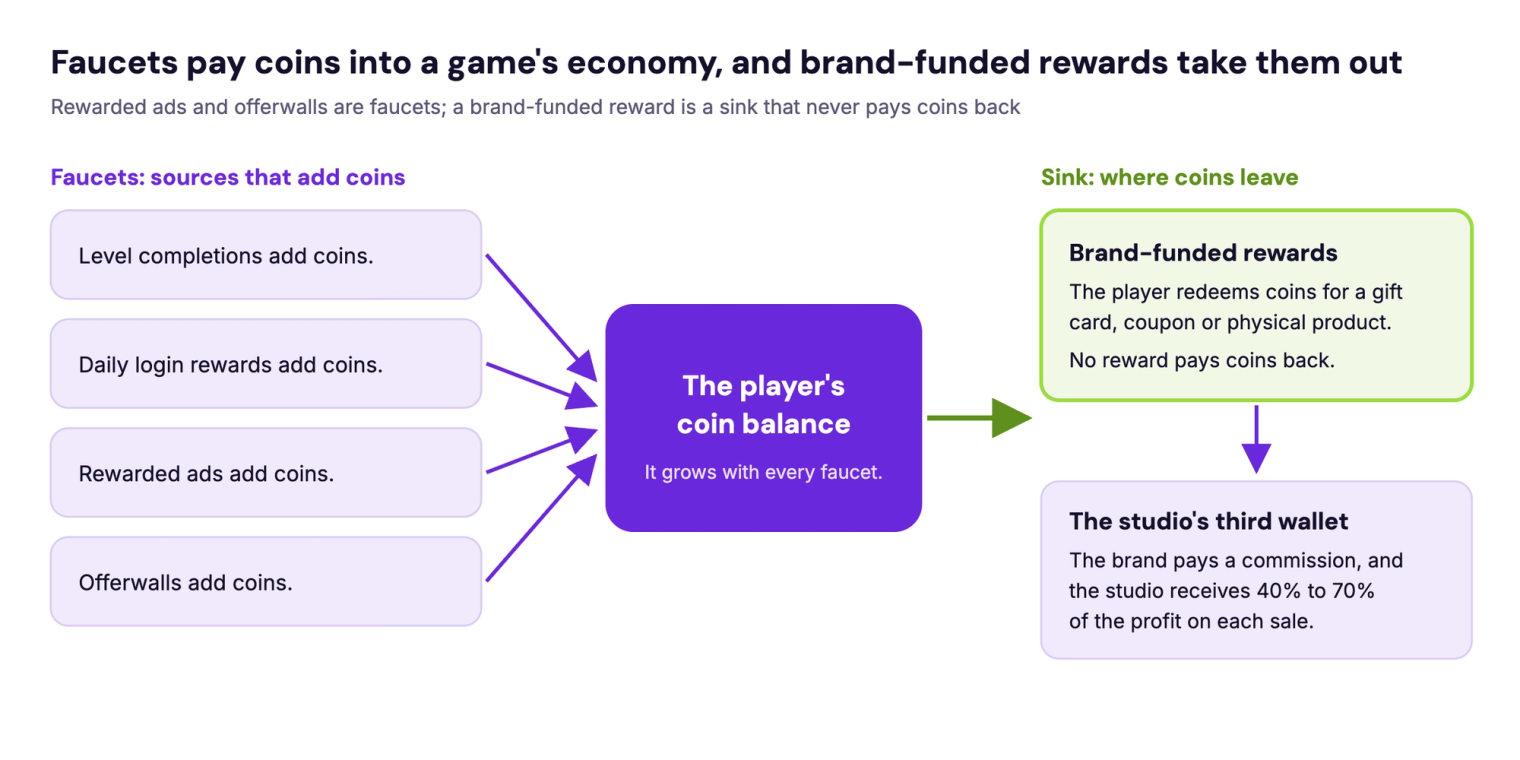
Every reward format in a game either pays coins into the economy or takes them out. A rewarded ad gives the player coins or an extra life for watching a video ad, and Unity's game economy guide names rewarded ads among the most important faucets, the sources that pay currency into a game. An offerwall gives the player a reward, such as extra game currency, for completing an advertiser's task. Brand-funded rewards work the other way: redeeming a reward only spends coins and never pays coins back, so they are a currency sink that does not inflate the economy.
Brand-funded rewards are one form of gaming commerce, the sale or redemption of real products inside a game.
What are the three wallets of mobile game revenue?
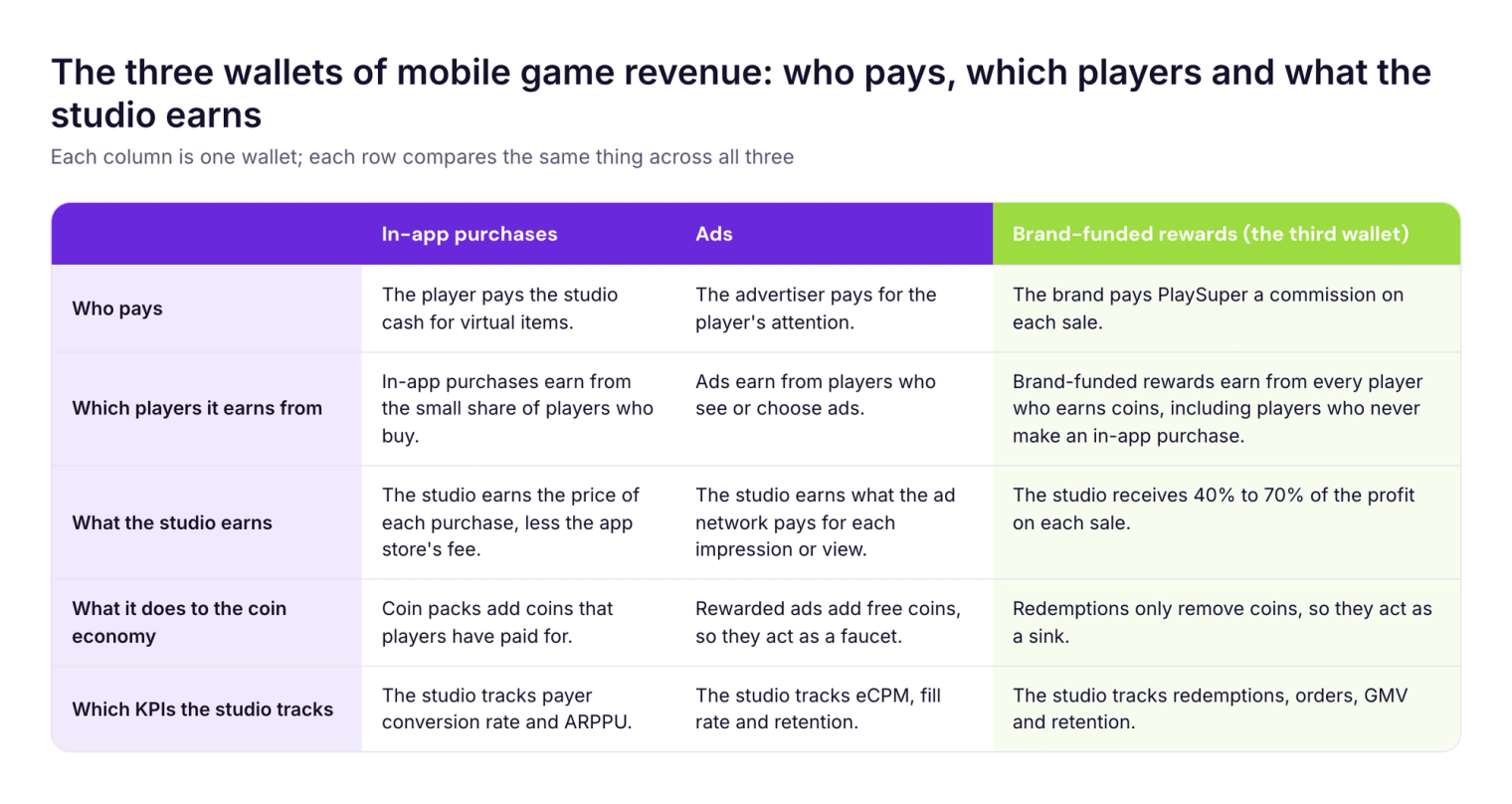
The three wallets are in-app purchases, paid for by players; ads, paid for by advertisers; and brand-funded rewards, paid for by brands each time a player redeems coins for one of their products.
The 2024 Unity Gaming Report puts the median share of daily active players who made an in-app purchase at 0.5% in 2023, down from 0.7% in 2021. The third wallet is open to every player who earns coins, not only those who never pay, and it reaches players who skip in-app purchases but keep a lifestyle budget.
How does the third wallet earn money for a studio?
A brand configures a discount on its own product, the player covers part of the price with coins earned in the game, the brand pays PlaySuper a commission on the sale, and PlaySuper pays the studio a revenue share.
The studio receives 40% to 70% of the profit, depending on how many daily active players its game has. The studio sets the value of each coin, which decides each reward's coin price. Your Currency Potential estimates the share for your game.
The PlaySuper SDK carries rewards from 3,000+ brands and runs in 23 games with 10M+ game DAU, where 896K players open the rewards each day.
Why do studios add a third wallet?
Studios add a third wallet for player retention and for end-to-end analytics of every reward.
Interstitial ads and in-app purchase prompts interrupt play, and a game that shows too many of them loses players. Brand-funded rewards appear at the game's high-engagement, high-dopamine moments, such as after a win, a level-up or a milestone, so the reward adds to the session instead of stopping it.
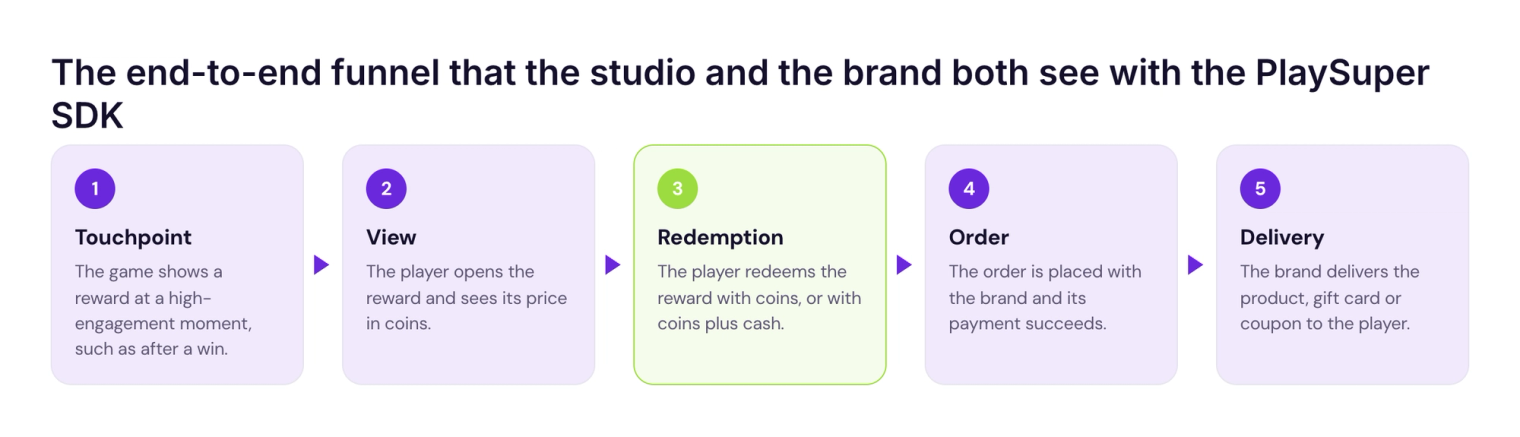
Ad and conversion analytics are fragmented today: each ad network reports its own impressions, and the advertiser keeps the sales data. PlaySuper manages both the studio side and the brand side, so we give both one end-to-end funnel view, from touchpoint to delivery, together with the conversions. Studios also see what their players buy and which brands they prefer.
Why does it matter that the third wallet is a currency sink?
A sink matters because coins that players cannot spend lose their value.
Daniel Godley's game economy guide for Unity warns that without enough sinks, "players stockpile rewards until nothing feels worth earning or buying." Rewarded ads and offerwalls add coins as faucets. Each brand-funded redemption removes coins from the player's balance instead, and the brand funds the discount that those coins cover.
What has the third wallet done in live games?
In three live games, brand-funded rewards raised ARPDAU or retention against players who did not see them.
In CallBreak, a card game by Teslatech, two native reward tiles in the lobby went to 10% of players, with the other 90% held back as a control group. ARPDAU rose 52% among exposed players and 5.2% across the full 1M DAU base, and brand GMV reached $53K a month.
Masala Express, a casual cooking game by Cympl, gained 5.8pp in D7 retention across 821 matched player pairs. Appon's World of Carrom gained 3.6pp in D7 retention against matched digital twins.
The control group decides what a result proves. Unity's offerwall post reports 3.8 times higher D14 retention for players who engage with its offerwall, but those players chose to open it, while a random holdout like CallBreak's measures the rewards alone.
Which games can add a third wallet?
The third wallet works best for studios with at least 50K DAU whose games run free-to-play or freemium economies, but the PlaySuper SDK is not limited by game size and can go into a game before launch.
A game without an earned currency can add a soft currency that players earn through simple game loops or level-ups. Real-money games can use brand-funded rewards to give players brand rewards instead of paying cash out directly. Brand-funded rewards are the wrong first choice for an in-game placement whose only goal is the most ad revenue per session and where player retention does not matter. Even there, they give studios insight into what their players buy, which studios have not had until now, and a studio can add them later without changing its ads or IAP.
FAQ
Does "third wallet" mean something else outside games?
Yes. In impact investing, Social Finance uses the term for "a flexible pool of capital that sits alongside traditional grantmaking and market-rate investing." In mobile games, it means the revenue line that brand-funded rewards create.
Does the third wallet replace in-app purchases or ads?
No. It adds a third revenue line beside them, and the studio's ad optimization and IAP flows stay as they are when it adds the PlaySuper SDK.
How fast can a studio add brand-funded rewards to a game?
A studio usually takes 1 to 2 hours. That is the average time to go live with the PlaySuper SDK on our self-serve console.
Has a game given players real-world rewards before?
Yes. PLAYSTUDIOS, a mobile game publisher, runs playAWARDS, a loyalty platform on which players exchange loyalty points earned in its games for real-world rewards. Its first-quarter 2026 results report that players purchased approximately 169,000 rewards with a retail value of $15 million in the quarter.
See what brand-funded rewards could add to your game's revenue on Your Currency Potential.
- Monetisation