How does advertising in video games work?
How advertising in video games works: how an ad is requested, auctioned, shown and counted, the main formats, the platform rules and who gets paid.

Advertising in video games works like a fast auction. When a game reaches an ad moment, its ad SDK sends a request, ad networks bid in real time, and the winning ad appears inside the game, next to it or around it. The ad network then pays the studio for each counted impression or completed view.
Every dynamic in-game ad, from a billboard in a racing game to a rewarded video in a puzzle game, goes through the same five steps. A brand buys the ad, the game requests it, an auction picks it, the game shows and counts it, and the ad network pays the studio. The IAB's creative guidelines for gaming then sort ads by where they sit: "in the game", "next to the game" or "around the game".
Key numbers
- 3.6 billion people played games in 2025, and 44% of them spent money on games, according to Newzoo figures reported by GamesMarket.
- An intrinsic in-game display ad counts as viewable when 50% of its pixels are on screen for one continuous second, under the IAB and MRC measurement guidelines.
- Google AdMob bans cash, cryptocurrency and gift cards as rewards for watching an ad, and it caps a discount on a physical item at 25% of the item's value, according to Google's rewarded ads policy.
What is advertising in video games?
Advertising in video games is any paid brand message that a player sees inside a game, beside it or between rounds of play. It splits into in-game ads, which appear while someone plays, and advergames, which are games built to promote a brand.
In-game ads come in two technical kinds. Static ads are hard-coded into the game and cannot change after release. Dynamic ads are served over the internet while the game runs, so the brand, the creative and the target audience can change from one day to the next.
How does an in-game ad get from a brand to a player's screen?
An in-game ad reaches the player's screen through an ad request and a real-time auction. The game decides when an ad may appear, and the auction decides which ad appears.
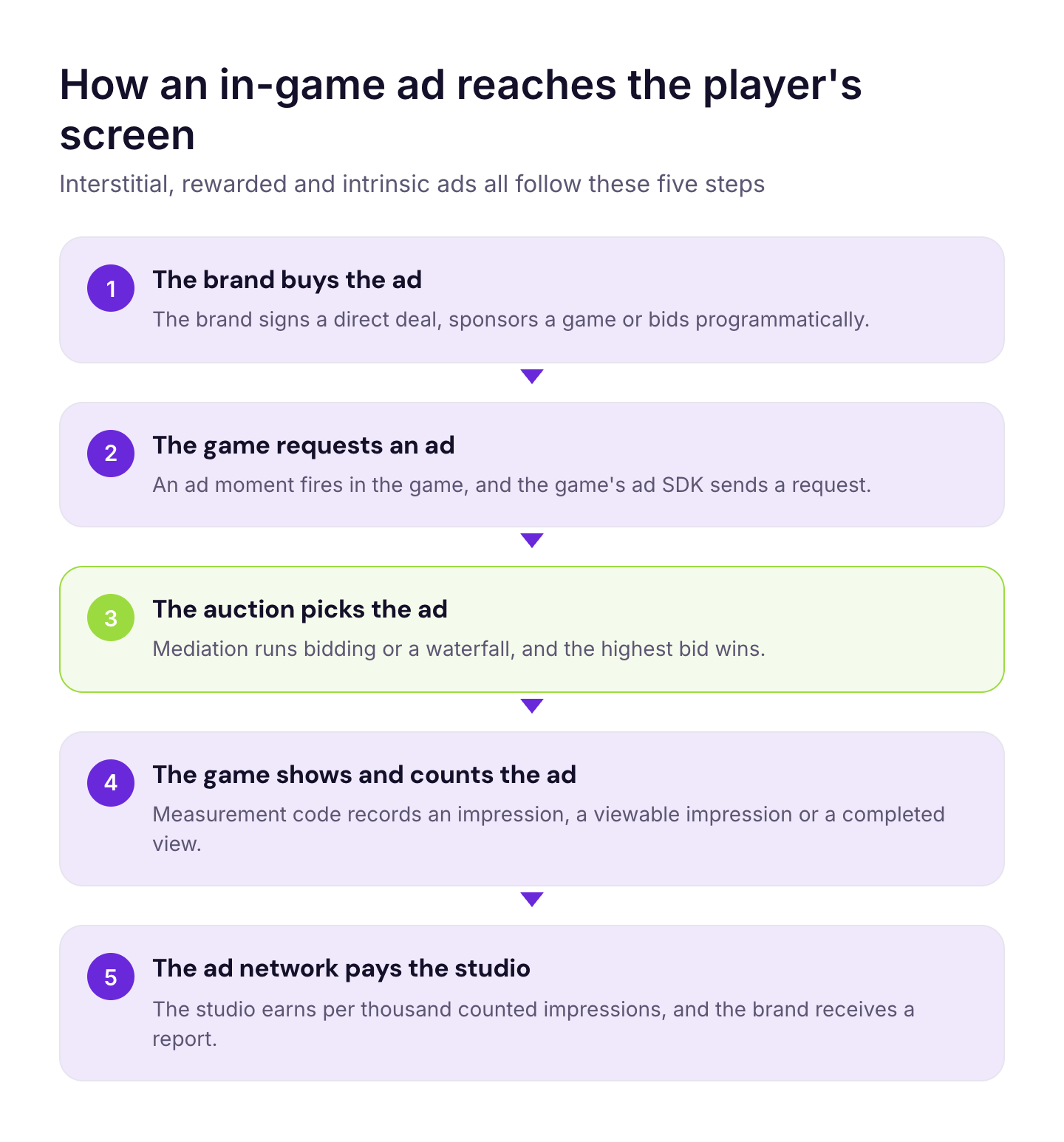
- The brand or its agency buys the ad. It can sign a direct deal with fixed prices and guaranteed impressions, sponsor a game, or bid programmatically through real-time bidding, a private marketplace or a programmatic guaranteed deal.
- The game reaches an ad moment, such as the end of a level or a player tapping "watch for coins", and the game's ad SDK sends an ad request.
- A mediation layer chooses which ad network fills the request. AdMob's mediation guide describes two setups. In bidding, ad sources compete in a real-time auction and the highest bid wins; in a waterfall, the mediation layer calls sources one by one in an order the studio sets by average eCPM.
- The game shows the ad, and the measurement code counts an impression and then checks whether the ad was viewable or watched to the end.
- The ad network pays the studio for counted impressions, and the brand receives a report on what it bought.
The studio controls steps 2 and 4: where the ad moments sit in the game, how often they fire and which formats the game allows. The brand controls step 1 and the creative.
What in-game advertising formats can brands and studios use?
Brands and studios choose between four main formats: interstitial ads, rewarded ads, intrinsic ads and brand-funded rewards. Interstitial ads deliver reach, rewarded ads deliver completed views and installs, intrinsic ads deliver attention and recall, and brand-funded rewards deliver player retention and player insights.
The IAB Gaming Ad Formats Framework lists intrinsic in-game, rewarded, interstitial, adjacent and sponsorship among its display formats. Brand-funded rewards are not an ad unit. They belong to gaming commerce, the category in which players redeem in-game currency for real products inside the game. Interruption matters because every interstitial and every in-app purchase prompt stops play for a moment, and a game that shows too many of them loses players. Studios therefore weigh each format by its effect on player retention as well as by what it earns.
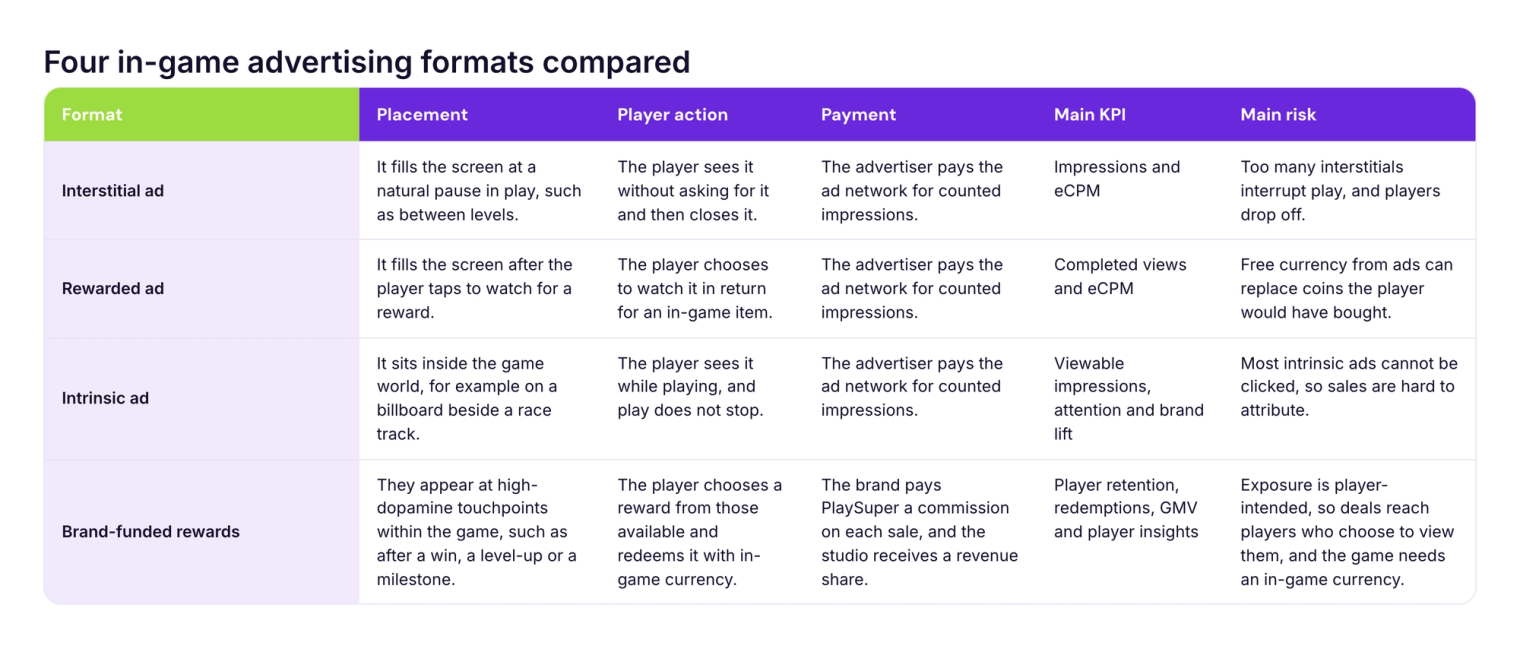
Interstitial ads are full-screen ads that a game shows at natural pauses, such as between levels, as Google's developer guide describes.
Rewarded ads trade a player's attention for an in-game item. AdMob's overview of rewarded ads says that the game serves one only after the player chooses to view it, in exchange for a reward such as an extra life or in-app currency.
Intrinsic ads sit inside the game world, such as a billboard beside a race track. Anzu, an in-game ad network, describes them as non-clickable in its explainer, and on 9 February 2026 Anzu announced click-enabled intrinsic formats for performance campaigns.
How are in-game ads measured and paid for?
In-game ads are counted as impressions, viewable impressions or completed views, and studios track their earnings as eCPM, the revenue per thousand impressions.
For intrinsic ads, the IAB and MRC guidelines set the standard. A display ad counts as a viewable impression when at least 50% of its pixels are visible for one continuous second, and a video ad needs 2 continuous seconds. For intrinsic campaigns, the same guide points buyers to viewability, attention and brand lift as their KPIs, because a billboard that the player cannot click leaves no click to track.
Rewarded ads are measured on completion. AdMob offers server-side verification, so the studio grants the reward only to players who watched the ad to the end, as its rewarded ad unit setup page explains.
Each network in a studio's mediation stack reports its own impressions and eCPM. Ad data and conversion data therefore sit in separate reports, and building one funnel from the first ad view to a sale takes extra work for the studio and for the brand.
What rules limit where in-game ads and rewards can appear?
Ad platforms set firm rules on where ads may interrupt play and on what a player may receive for watching one.
AdMob's interstitial policy bans interstitial ads when an app loads and when it exits, and it allows no more than one interstitial after every two actions a player takes, such as clicks or swipes. It also bans ads that appear while a player is focused on a task, because interstitials belong at logical breaks between levels or stages.
Rewarded ads must be opt-in. Under AdMob's rewards policy, the player must first tap a button that accepts the ad. The player must be able to skip the ad, and the game must disclose the reward before the ad plays. The same policy is strict about money: "Direct monetary items may not be offered as rewards under any circumstance." It names cash, cryptocurrency and gift cards as examples, and it caps a discount on a physical product at 25% of the product's value.
This policy is why a game cannot pay players in gift cards for watching ads. To put real products inside a game, a studio needs a model in which the brand pays for the reward itself.
Where do brand-funded rewards fit in in-game advertising?
Brand-funded rewards keep players in the game: players redeem the coins they earn in play for real products that brands discount, the brand pays for each sale, and the studio pays nothing.
This is the model the PlaySuper SDK runs. A studio integrates the SDK into its game, and players redeem the coins or gems they earn during play on a catalog of physical products and popular lifestyle and gaming gift cards from 3,000+ brands. That gives hard-earned game currency real value beyond the game, so players keep playing to earn more. Each brand sets a discount on its own products, and that discount lets in-game currency cover part of the price. Gift cards and physical products also carry a coins plus cash option. The studio sets what a coin is worth, so the studio decides how many coins each reward costs.
The studio never pays us. The brand pays us a commission on every sale of physical products and gift cards, and brands can also run cost per sale, cost per engagement or cost per click campaigns as coupons and banners. We pay the studio a revenue share of 40% to 70% of the profit, depending on how many daily active players the game has. We call this revenue line the third wallet, because it sits beside in-app purchases and ads.
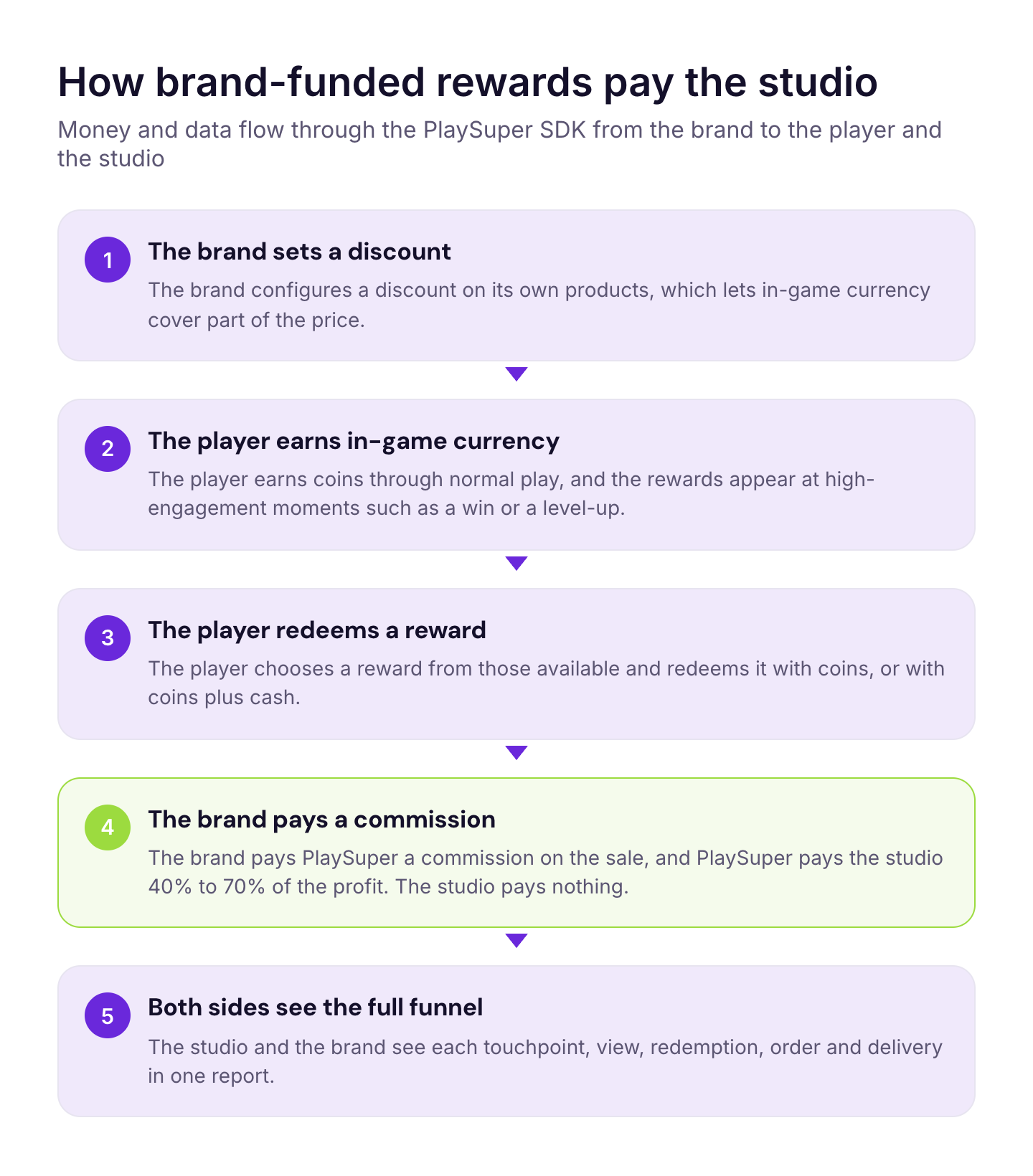
Where the rewards appear depends on the game. Studios place them at high-engagement, high-dopamine moments, such as after a win, a level-up or a milestone, so the rewards add value without stopping play and keep players in the game. Because PlaySuper works with both the studio and the brand, both sides see one end-to-end funnel, from the touchpoint and the view to the redemption, the order and the delivery, together with the conversions.
The KPIs for brand-funded rewards are redemptions, orders and GMV for the brand, and playtime and retention for the studio. In the CallBreak case study, the studio Teslatech added two native tiles to the game's existing lobby and showed them to 10% of players, with the other 90% as a control group. ARPDAU rose 52% for exposed players and 5.2% across the full 1M DAU base. The tiles produced $53K in brand GMV per month at a click-through rate of 10 to 15%. In Masala Express, the coin earn rate rose 42% and day 7 retention rose 5.8 percentage points across 821 matched player pairs. Our network covers 23 games with 10M+ game DAU, and 896K players a day open the rewards inside those games, where they can redeem gift cards and coupons.
Brand-funded rewards win when the goal is player retention and insight into what players redeem.
When is each in-game ad format the wrong choice?
Interstitial ads are the wrong choice in games without clear stopping points. AdMob's interstitial guidance says that they suit apps with linear experiences and suggests banners for other apps.
Rewarded ads are the wrong choice when the reward is the same currency that players buy, because free currency from an ad can replace a purchase.
Non-clickable intrinsic ads are the wrong choice for a brand that needs a sale it can attribute this quarter, because their strength is attention and recall.
Brand-funded rewards are the wrong first choice when you need the widest reach fast and player retention is not the goal. They also give studios insight into what their players redeem and which brands they prefer, which studios have not had until now. For the strongest monetization, the PlaySuper SDK works best for studios with at least 50K DAU whose games run free-to-play or freemium economies, but integration is not limited by game size, and a studio can add the SDK to a game that has not launched yet. Games without an in-game currency can still use brand-funded rewards by introducing a soft currency that players earn through simple game loops or level-ups. Real-money games that already hold a wallet for their players can integrate brand-funded rewards too, giving players brand rewards instead of cash.
The formats can run side by side, because brand-funded rewards add the third wallet while the game's ad mediation and in-app purchase setup stay as they are. Redeeming a reward only spends coins and never pays coins back, so brand-funded rewards do not inflate the game's economy.
FAQ
Can a game show ads without interrupting play?
Yes. Intrinsic ads sit in the game world, adjacent banners sit beside the game, and audio ads play over gameplay without pausing it, according to the IAB's gaming creative guidelines.
Can players earn gift cards by watching ads in a game?
Not through Google's ad units. AdMob's rewards policy bans cash, cryptocurrency and gift cards as rewards for watching ads, and it caps discounts on physical items. Games that offer real products do so through brand-funded rewards, which the brand pays for.
Who pays for a real-world reward inside a game?
The brand pays for it. With the PlaySuper SDK, each brand sets a discount on its products and pays us a commission on every sale of physical products and gift cards. The studio pays nothing and receives a revenue share.
How long does it take a studio to add brand-funded rewards to a game?
Brand-funded rewards run alongside a game's ad mediation and in-app purchases, so the studio does not need to change either setup. The PlaySuper SDK usually goes live in 1 to 2 hours on our self-serve console, and a studio can add it before the game launches.
Reach players with rewards they choose
If you are a brand planning your first in-game campaign, start with the goal: reach, recall, clicks or player retention and insights. If it is retention and insights, talk to our team about brand-funded rewards.
- Monetisation