What is gaming commerce?
Gaming commerce is the sale or redemption of real products inside a game. See its three types, who pays in each, and how brand-funded rewards work.
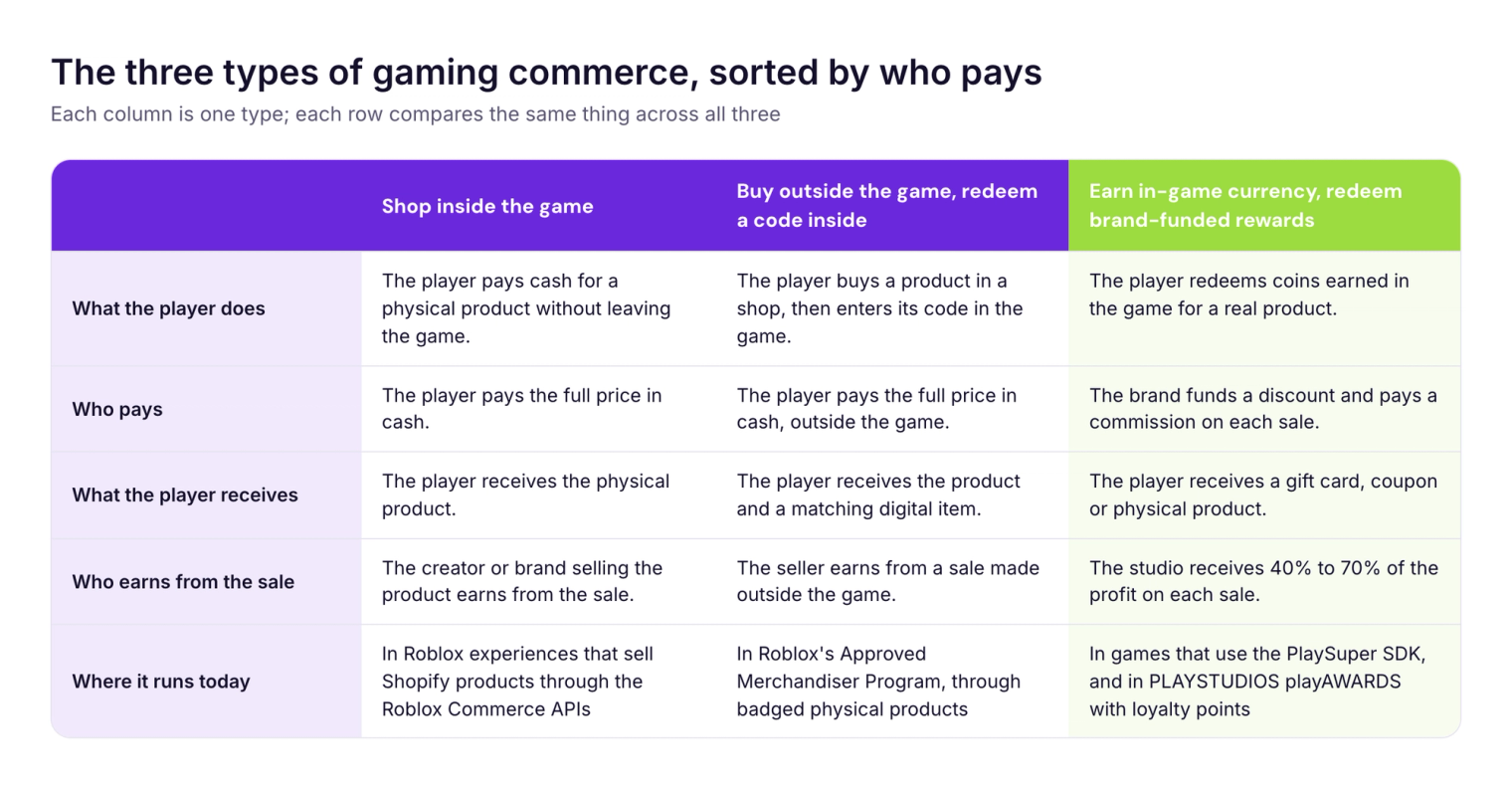
Gaming commerce is the sale or redemption of real-world products inside a game, without the player leaving it. It takes three forms, sorted by who pays: the player buys a product with cash, a purchase made outside the game comes with a code for an item inside it, or the player redeems earned in-game currency for brand-funded rewards.
What does gaming commerce mean?
Gaming commerce means that a game sells or hands out real-world goods, such as gift cards and physical products, inside its own interface. With in-app purchases, by contrast, players pay cash for virtual items that stay in the game.
The short form "g-commerce" goes back at least to 2021, when GamesBeat and PocketGamer.biz covered Sayollo's gComm, a shopping platform built into mobile games. For a studio, the deciding question is who pays, and the answer differs in each form.
What are the three types of gaming commerce?
The three types are shopping inside the game, buying outside the game and redeeming a code inside it, and earning in-game currency to redeem for brand-funded rewards. The player pays in the first two types, and a brand pays in the third.
Shop inside the game
The player pays cash for a physical product without leaving the game. In May 2025 Roblox opened its Commerce APIs, with Shopify as the first partner, so that eligible creators and brands can sell physical products in their experiences. TechCrunch reported that the feature launched for US players aged 13 and up.
Buy outside the game, redeem a code inside
The player buys a product in a shop, then enters a code in the game to receive a matching digital item. TechCrunch reported that badged products in Roblox's Approved Merchandiser Program carry such a code.
Earn in-game currency, redeem brand-funded rewards
The player earns in-game currency by playing and redeems it for a gift card, coupon or physical product whose discount a brand funds. Studios add brand-funded rewards to their games with the PlaySuper SDK. PLAYSTUDIOS, a mobile game publisher, runs a similar loyalty platform called playAWARDS, where players exchange loyalty points for real-world rewards from partners such as MGM Resorts. With brand-funded rewards, the studio pays nothing and earns a revenue share on every redemption.
How do brand-funded rewards work in a mobile game?
A brand discounts its product, a player redeems coins earned in the game against the price, the brand pays PlaySuper a commission on the sale, and the studio receives a share of the profit.
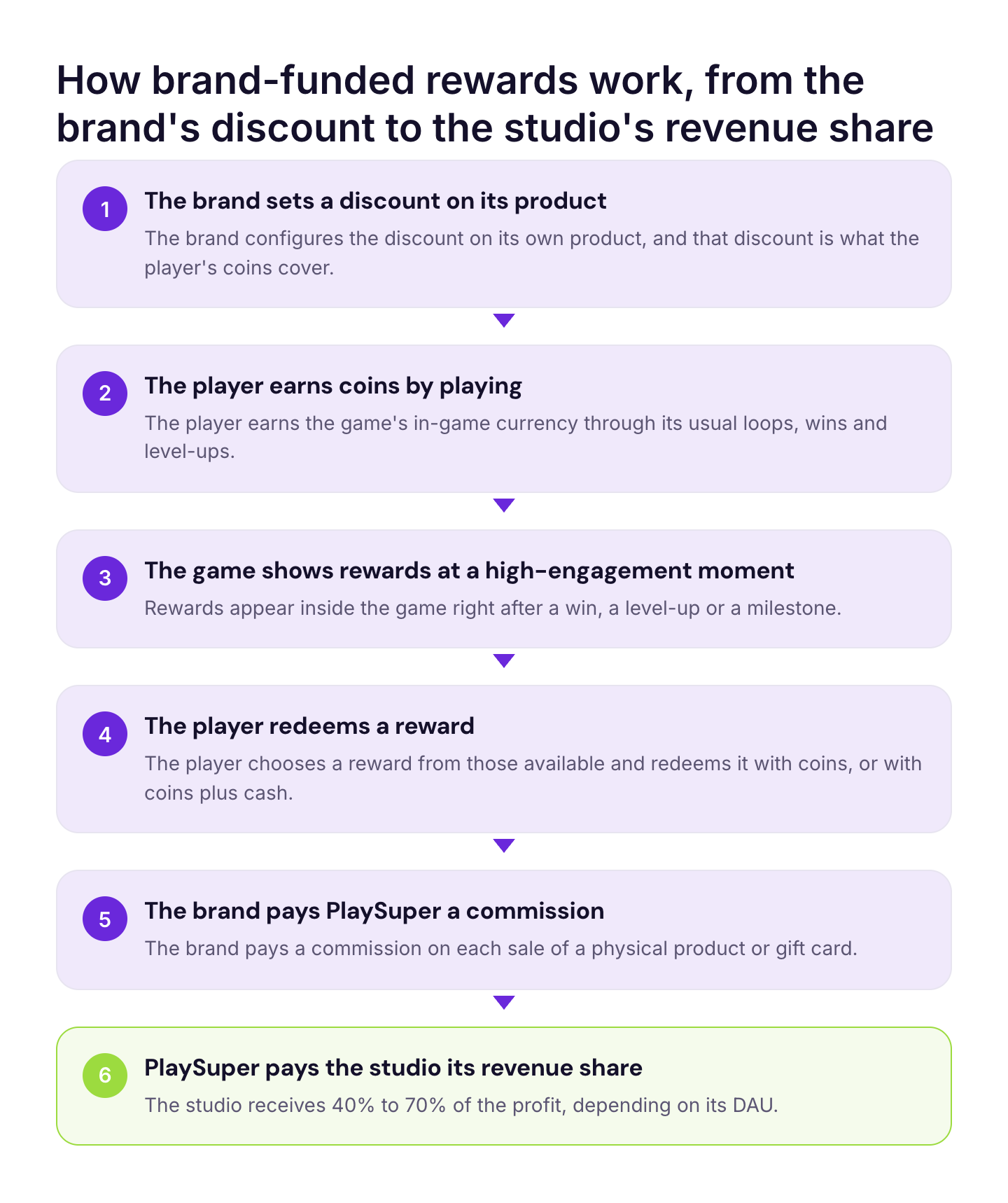
With the PlaySuper SDK, players redeem the coins or gems they earn during play on a catalog of physical products and popular lifestyle and gaming gift cards from 3,000+ brands, in a storefront that matches the game's look. Hard-earned currency gains real value beyond the game, so players play longer to earn more: in Masala Express, the coin earn rate rose 42%. The studio sets the value of its coin and receives 40% to 70% of the profit, depending on its DAU. Rewards have no fixed screen: each studio places them at its game's high-engagement, high-dopamine moments, such as after a win, a level-up or a milestone.
Why do studios add brand-funded rewards?
Studios add brand-funded rewards to keep players in the game and to see each step from reward to delivery. Interstitial ads and purchase prompts interrupt play, and too many of them make players drop off. A reward redeemed at a high-engagement moment adds to the session instead of interrupting it.
Ad and conversion analytics are fragmented across ad networks. Because PlaySuper works with both the studio and the brand, we give both sides an end-to-end funnel view, from touchpoint and view to redemption, order and delivery. Studios see what players redeem and which brands they prefer; brands see orders, GMV and cancellations.
What does gaming commerce look like in a live game?
In CallBreak, a card game from Teslatech with 1M DAU, the studio showed two native PlaySuper reward tiles to 10% of players and kept the other 90% as a control group. Players who saw the tiles generated 52% more ARPDAU (average revenue per daily active user), a 5.2% lift across the whole base, and brands recorded $53K a month in sales, as the CallBreak case study shows.
How is gaming commerce different from in-game ads and offerwalls?
In-game advertising sells the player's attention to a brand, and an offerwall pays players currency for an advertiser's task, such as installing an app. With brand-funded rewards, the player spends currency already earned, and the brand pays a commission when the player redeems a product. We call this revenue line the third wallet, beside in-app purchases and ads.
Which games can use brand-funded rewards?
Brand-funded rewards work best for studios with at least 50K DAU whose games run free-to-play or freemium economies. Integration is not limited by game size, and a studio can add the PlaySuper SDK to a game before it launches.
A game without an earned currency can introduce one that players earn through simple game loops or level-ups, and a real-money game can give players brand rewards instead of paying cash out directly. Rewards are available to players in the US and India.
Brand-funded rewards are the wrong first choice when a studio needs the widest reach fast and retention is not the goal. They also give studios insight into what their players buy, which studios have not had until now. Because ad and in-app purchase flows stay as they are, a studio can add the PlaySuper SDK later without removing anything.
FAQ
Who pays for real-world rewards in a game?
With brand-funded rewards, the brand pays. The brand funds a discount, the player covers that part of the price with earned coins, and the brand pays us a commission that we share with the studio.
Who decides what a coin is worth?
The studio does. The value it sets for its coin decides each reward's coin price.
How fast can a studio add brand-funded rewards to a game?
With the PlaySuper SDK, rewards usually go live in 1 to 2 hours on our self-serve console.
Does gaming commerce replace in-app purchases?
No. Brand-funded rewards add a separate revenue line, the third wallet, beside in-app purchases and ads. Redeeming a reward only spends coins and never pays coins back, so it does not inflate the economy.
See what your game's currency could earn on Your Currency Potential, or browse our resources for studios.
- Monetisation