Xsolla Alternatives: Aghanim, Appcharge, Neon Pay, Coda
A mobile game web shop is a store on your own website where players pay real money for the game's digital items, so the studio keeps more of each sale. It earns only from the few players who already pay. PlaySuper's brand-funded rewards reach the rest: players redeem coins earned in play for real products, and brands pay.
| Feature | PlaySuper | Xsolla, Aghanim, Appcharge, Neon Pay and Coda web shops |
|---|---|---|
| Who it serves | Serves every player who earns coins | Serves only real-money payers |
| Where the player pays or redeems | Redemption happens inside the game | Player leaves the game to pay |
| What earned coins become | Earned coins buy real products | Earned coins stay digital |
| Who runs the store | PlaySuper runs the store, 3,000+ brands | Studio runs a second store |
| What it adds | Adds retention and revenue per redemption | Adds margin, not new payers |
| What the studio pays | Studio never pays PlaySuper | Vendor takes a share of each sale |
The main Xsolla alternatives for a mobile game web shop are Aghanim, Appcharge, Neon Pay and Coda. Each sells the game's digital items for real money on the studio's website, and all of them earn only from players who already pay; PlaySuper's brand-funded rewards reach every player who earns coins, with brands and PlaySuper funding the discount.
A web shop moves existing payers to a checkout the studio controls and adds margin but no new payers. Brand-funded rewards earn from every player who earns coins, with brands and PlaySuper funding the discount and the studio earning a revenue share.
Key takeaways
- A web shop is a second checkout on the studio's website, where players who already pay real money buy the game's digital items.
- Apple and Google now allow US link-outs, but the iOS fee is still in court, so model it above zero as well as at zero.
- The merchant of record is the vendor choice that matters most, because it carries the tax, refunds, chargebacks and fraud of every sale.
- A web shop pays off only when the vendor's all-in rate is below the store fee, so a small developer on the reduced store rate needs a vendor at the bottom of the range.
- A web shop earns only from paying players and does nothing for the coins most players earn and keep inside the game.
- PlaySuper's brand-funded rewards close that gap by giving every player's earned coins real-life value inside the game, funded by brands and PlaySuper, never by the studio.
- Skip a web shop when impulse purchases drive revenue or players cannot be reached outside the game; skip rewards when pack margin is the only goal.
What is a mobile game web shop?
A mobile game web shop is a store on the studio's own website where players pay real money for the game's digital items, which then appear in their game account. PocketGamer.biz's guide to choosing a web store platform defines it as "a direct-to-consumer store in which developers and publishers sell digital items and bundles to their players."
The shop is a second checkout for the studio's existing payers. The same guide says these stores "are not a replacement for the in-game stores we're all accustomed to", and Apple's iOS rules keep it that way.
Why are studios launching web shops now?
Studios are launching web shops because games can now link US players to an outside checkout, after Epic's court cases against Apple and Google.
On iOS the fee is still moving. Apple has charged nothing on purchases US players make through an external link since the April 2025 contempt order in Epic v. Apple. A district court is now deciding what Apple may charge, while the Supreme Court reviews the contempt finding, according to 9to5Mac's report on the Supreme Court schedule. In August 2026 Apple proposed link-out rates of 15% for standard apps and 5% for Small Business Program apps, AppleInsider reported.
Google charges for the same route. Google Play has allowed US link-outs and alternative billing since October 2025, and Google's update for US developers says enrolled developers must report those transactions and pay service fees starting on October 1, 2026. Model the iOS case at Apple's proposed 15% as well as at zero, and launch only if the shop is profitable in both cases.
How does a web shop work, step by step?
A web shop sale takes five steps, from the player's sign-in to the studio's payout.
- The player signs in on the studio's site with a player ID or game account.
- The player pays real money at the web checkout.
- The merchant of record collects the payment and the sales tax.
- A webhook delivers the coins or bundle to the player's game account.
- The studio receives the net revenue.
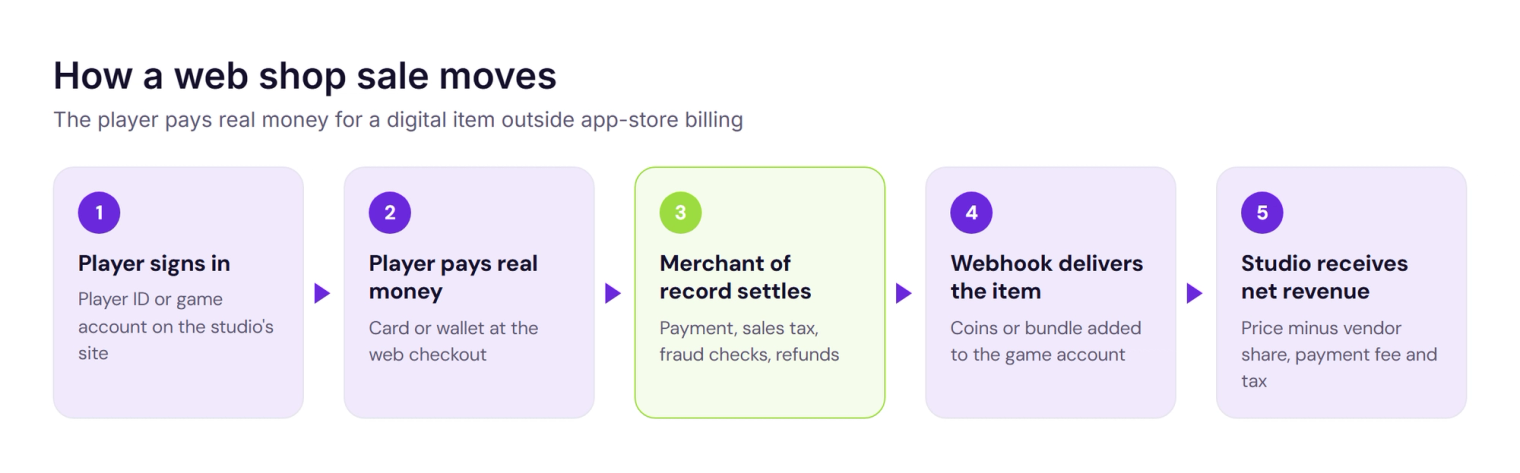
Pick the merchant of record first. Appcharge explains that a merchant of record "acts as the seller of record in transactions, assuming full financial liability for transactions, including taxes, chargebacks, and refunds." For US players the tax is concrete: Aghanim notes that in many sales tax jurisdictions "tax is added on top of the item price during checkout."
Xsolla's setup guide ties each sale to the right player: "Webhooks let you add items to a specific account in your game."
How much more does a studio keep through a web shop?
A studio keeps up to $2.50 more per $9.99 pack through a web shop, but only when the vendor charges less than the app store.
Take one $9.99 coin pack that a US iOS player buys with real money, before sales tax, refunds and chargebacks:
| Route | Who takes the cut | Cut | Studio keeps |
|---|---|---|---|
| App Store, standard | Apple | 30% | $6.99 |
| App Store, small developer | Apple | 15% | $8.49 |
| Web shop via iOS link-out, cheapest vendor | Vendor | 5% | $9.49 |
| Web shop via iOS link-out, priciest vendor | Vendor | 15% | $8.49 |
In a web shop, the player pays on the studio's own site through a link in the game, so Apple takes nothing on US link-outs as of November 2026. The vendor takes "anything from 5 to 15 percent, depending on the company," according to PocketGamer.biz. On Android the web-shop rows also carry Google's service fee on US link-outs, so the gain there is smaller.
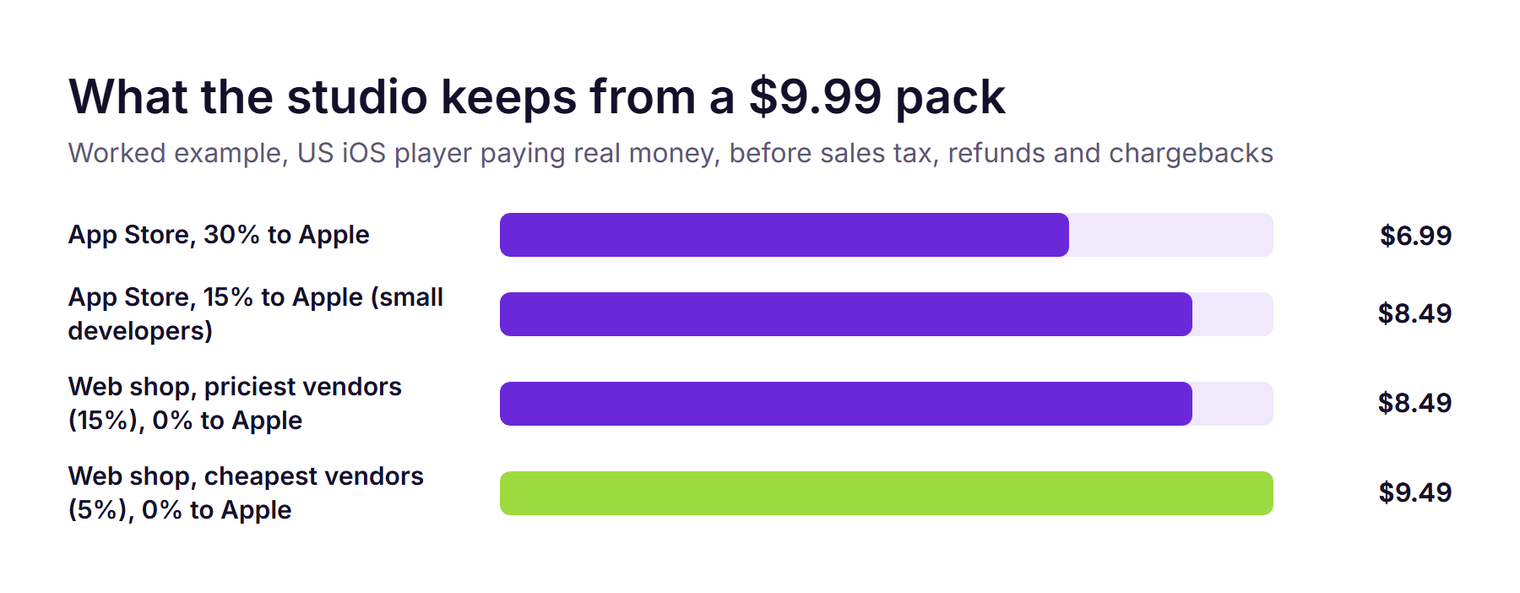
The $2.50 gap matters most to studios that pay the full 30% today. A small developer already on the reduced rate gains nothing at a 15% vendor share, so it needs a vendor near the bottom of the range. If Apple wins its proposed 15% link-out fee, a studio on the 30% rate still keeps about $1 more per $9.99 pack through a 5% vendor, and a small developer at Apple's proposed 5% link-out rate gains only through a vendor charging less than 10%.
How do Xsolla, Aghanim, Appcharge, Neon Pay and Coda compare?
Xsolla, Aghanim, Appcharge, Neon Pay and Coda all run web shops that sell digital items for real money, and they differ mainly in pricing and in what they add around checkout.
| Vendor | What it sells | Tax and compliance | Notable extra |
|---|---|---|---|
| Xsolla | In-game items, currencies, subscriptions | Merchant of record service | Non-payer monetization tools |
| Aghanim | Currency packs, passes, subscriptions | Payments compliance and taxes handled | Giveaways and creator programs |
| Appcharge | Personalized offers and storefronts | Taxes and payment processing handled | In-app payment links |
| Neon Pay | Shops and in-game checkout | Tax, fraud protection, payouts | Fixed all-in pricing |
| Coda | Digital goods in branded web shops | Merchant of record service | Codashop consumer storefronts |
Xsolla
Xsolla describes Web Shop as "a direct-to-consumer ecommerce solution for mobile games" that sells in-game items from the studio's own website. The shop sits inside a wider suite with Pay Station checkout, anti-fraud, player login, subscriptions and a Rewards product that hands out digital items. Its setup guide states a rate of "only 5% per transaction". Xsolla suits a studio that wants payments, shop and login from one vendor.
Aghanim
Aghanim offers "secure, compliant web-based mobile game monetization" and acts as merchant of record for sales, delivery and returns. Studios sell "currency packs, items, lootboxes, passes, and subscriptions" and can add giveaways and programs for content creators. Aghanim suits a studio that wants web incentives and creator programs next to its shop.
Appcharge
Appcharge pitches "Better payments for mobile studios" through personalized web stores, in-app payment links, a self-optimized checkout and a merchant of record service. Its storefronts promise "Pixel perfect custom storefronts and player-level personalization." Appcharge suits a studio that wants offers tailored to each player.
Neon Pay
Neon Pay sells "Direct-to-consumer commerce solutions, built for games" through Neon Shop, Neon Checkout and an in-game Neon Direct Checkout, with tax, fraud protection and payouts included. Its pricing pitch is "All-in pricing that never changes." Neon Pay suits a studio that wants a fixed, predictable rate.
Coda
Coda lets a studio "Launch a branded D2C webstore with everything you need to sell, engage, and grow", with Coda Links for link-outs and a merchant of record service. Coda also runs consumer storefronts such as Codashop. Coda suits a publisher that wants reach through Coda's own consumer storefronts.
What should a studio ask every web shop vendor?
Ask every vendor for its rate in writing, because the headline rate is rarely the whole cost. PocketGamer.biz warns that some providers "have many types of hidden fees that lead to lower margins than expected." Put six questions to every vendor and price one $9.99 pack with the answers:
- What share does the vendor take on each sale?
- Is payment processing inside that share or on top?
- Who registers for, collects and remits sales tax?
- Who absorbs refunds and chargebacks, and at what fee?
- Does the rate differ for in-game link-outs and direct traffic?
- How do players log in, and how fast do items arrive?
What does a web shop not solve?
A web shop earns only from paying players, a small group in most free-to-play games. Unity's Mobile Growth and Monetisation Report 2024 and Moloco's State of Mobile Gaming 2025 both show few players making in-app purchases, with the top spenders bringing in most of the revenue.
The shop accepts no earned coins, so a player who never pays has nothing to buy there. Neon Pay says webshops "tend to work best for top spenders and frequent buyers."
Vendors are adding tools for everyone else, such as Xsolla's "non-payer monetization tools that let studios earn across every part of the player base", but those tools still hand out digital items. PlaySuper's brand-funded rewards give earned coins real-life value.
How do brand-funded rewards earn from the players a web shop misses?
With PlaySuper's brand-funded rewards, players redeem the coins they earn in play for gift cards, coupons and physical products, the brand and PlaySuper fund the discount, and the studio earns a revenue share on every redemption.
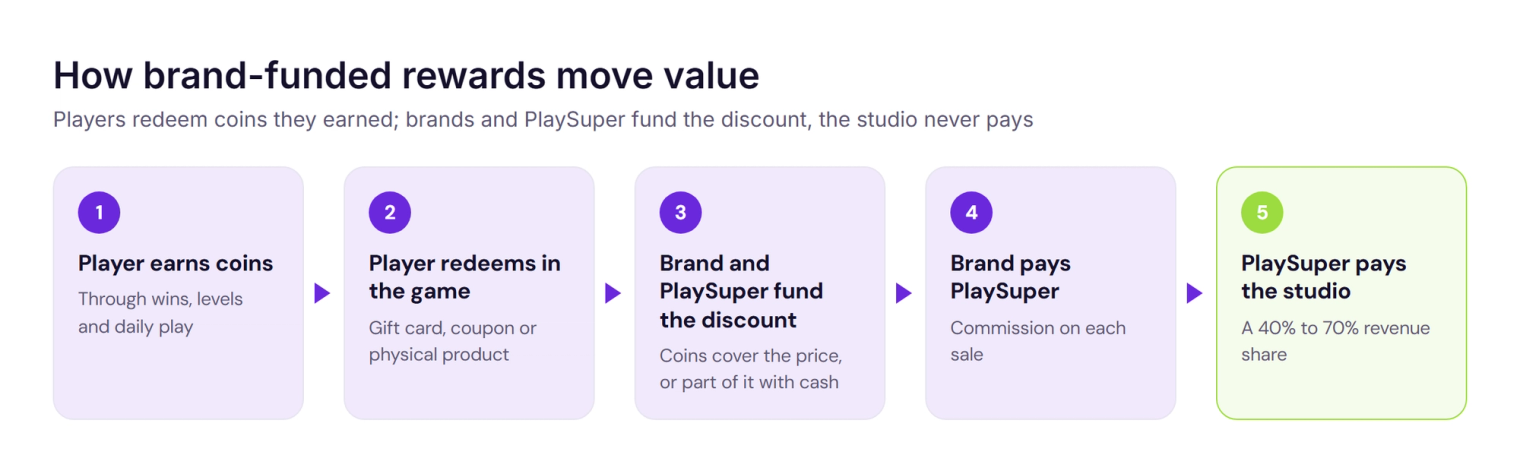
Players earn coins in play and redeem them inside the game through the PlaySuper SDK, from a catalog of 3,000+ brands. The brand and PlaySuper fund the discount on each product, and the brand pays us a commission on every sale. We pay the studio a 40% to 70% revenue share, set by DAU, and the studio never pays us. Coupons are redeemed with coins only, while every product and gift card also has a coins-plus-cash option where the player pays the rest in real money. No reward can be turned back into coins.
Store rules keep purchased currency and real-world rewards apart, and so do we: only currency earned through gameplay connects to the PlaySuper store. Apple's App Review Guidelines, last updated 16 October 2026, say in 3.1.3(e) that apps selling "physical goods or services that will be consumed outside of the app" must use "purchase methods other than in-app purchase". Google Play's Payments policy bars its billing for "the purchase or rental of physical goods", and adds: "In-app virtual currencies must only be used within the app or game title for which they were purchased."
For the game, the rewards are a side quest that brings players back to earn more coins. In our Masala Express case study, players with rewards showed a 5.8 percentage point lift in D7 retention and a 42% higher coin earn rate, measured against 821 matched player pairs. For the brand's side, see how brands fund rewards.
How do brand-funded rewards solve what a web shop cannot?
Brand-funded rewards solve each limit of a web shop because they earn from the coins every player already has, inside the game, with brands and PlaySuper funding the discount.
| Where a web shop falls short | How brand-funded rewards solve it |
|---|---|
| Serves only real-money payers | Serves every player who earns coins |
| Player leaves the game to pay | Redemption happens inside the game |
| Earned coins stay digital | Earned coins buy real products |
| Studio runs a second store | PlaySuper runs the store, 3,000+ brands |
| Adds margin, not new payers | Adds retention and revenue per redemption |
| Vendor takes a share of each sale | Studio never pays PlaySuper |
The web shop keeps serving payers while the rewards reach everyone else. Any game can add brand-funded rewards, before or after launch, and they pay off most for studios with at least 50K DAU.
When is each one the wrong choice?
A web shop is the wrong choice when most revenue comes from impulse purchases, when the studio cannot bring players to its site, or when it already pays the 15% Small Business rate and no vendor charges less.
PlaySuper's brand-funded rewards are the wrong tool if the only goal is a higher margin on packs that players already buy with real money. They add retention across every player who earns coins and a revenue share on every redemption, and they leave the price of a pack unchanged. Rewards reach players in the US and India today, so a game whose players are mostly elsewhere gains less for now. A game without an earned currency can create one, earned through simple loops or level-ups.
FAQ
Does a web shop replace in-app purchases?
No. A web shop adds a route, and in-app purchase stays. Apple's guideline 3.1.1 still requires in-app purchase for in-game currencies sold inside an iOS app, and a US app that links to the web must still offer in-app purchase alongside the link.
Do sales from direct web traffic owe a platform fee?
No platform commission applies. Unity's webshop business case explains that a player who arrives without an in-app link creates a transaction with "no in-app attribution, so no platform commission applies." The vendor's share and payment processing still apply.
Can players redeem currency bought with real money for real products?
No. Only currency earned through gameplay connects to the PlaySuper store, so currency bought with real money cannot be redeemed for real products. Google Play's policy also keeps currency bought in an app inside the game it was bought for.
How fast can a studio add brand-funded rewards to a game?
Most studios integrate the PlaySuper SDK and add the store in 1 to 2 hours. More can follow at high-engagement moments, such as a win or a level-up.
Who decides what a coin is worth when players redeem it?
The studio does. It sets each coin's value, which sets how many coins a reward costs, and it picks which soft currency to connect.
PlaySuper's brand-funded rewards add a third revenue stream beside in-app purchases and ads, funded by brands and PlaySuper. Estimate your players' coin value.
- Monetisation