Offerwall vs Rewarded Video vs Brand-Funded Rewards
Offerwall vs rewarded video vs brand-funded rewards: who pays, which way coins flow, how strong the retention proof is, and which one fits your game.
Choose rewarded video for steady ad revenue from players who want a quick boost. Choose an offerwall for the highest payout per engaged player, if your game has a scarce premium currency to hand out. Choose brand-funded rewards for retention and player insight, because players redeem the coins they earn on real products from brands without leaving your game.
Rewarded video and offerwalls earn from ad budgets; brand-funded rewards earn from brand budgets and keep players coming back. They work as a side quest beside your game loop: a player redeems coins earned in play for a gift card, coupon or physical product, then comes back to earn the next one, and you earn a revenue share on each sale.
How do an offerwall, rewarded video and brand-funded rewards compare?
Advertisers fund the offerwall and rewarded video; brands fund brand-funded rewards, which players redeem with coins earned in play.
| Offerwall | Rewarded video | Brand-funded rewards | |
|---|---|---|---|
| Who pays | Advertiser, per completed offer | Advertiser, per ad view | Brand, through a discount and commission |
| Player gives | Time on a third-party task | Time watching one short ad | Coins earned in play |
| Player gets | Premium currency | Coins, lives or boosts | Gift card, coupon or physical product |
| Leaves the game | Often, for installs and sign-ups | No, the ad plays in the game | No, redemption happens in the game |
| What it does to coins | Pays premium currency in | Pays coins in | Gives earned coins real value |
| Studio earns | Share of offer payouts | Ad revenue per view | Revenue share on each sale |
| Retention proof | Engagers vs non-engagers | Engagers vs non-engagers | Our case studies: matched pairs, holdout |
| Where it wins | Highest payout per engaged player | Reach across the player base | Retention and end-to-end player data |
| Main risk | Lost players and missing credits | Free coins undercut coin packs | Smaller reach; needs earned coins |
Payout per engaged player favors the offerwall and reach favors rewarded video.
What is an offerwall?
An offerwall is an in-game list of advertiser offers, such as installing another game and reaching a level in it, signing up for a service or answering a survey, that pays the player in-game currency for each offer completed.
The advertiser pays only when a player finishes an offer. Unity sells the Tapjoy offerwall to advertisers on those terms, and Digital Turbine's DT Offer Wall documentation says players "fulfill the offer requirements in exchange for virtual in-app currency." Because each completion is worth a lot to the advertiser, offerwalls post the highest eCPMs of any ad unit, according to Unity's offerwall fundamentals.
Kongregate tested an offerwall in one of its mid-core games and wrote, in a post republished by Game Developer, that it was "primarily utilized by non-payers". The same post lists what those players were asked to do: offers ranged from a video to "getting an insurance quote or subscribing to Netflix". So the format earns mostly from players who do not buy coin packs, and its best-paying offers are the ones that send those players out of your game.
An offerwall wins when your game has a premium currency players value and a core of committed players willing to earn it with tasks.
What is rewarded video, and what does it do to your coins?
Rewarded video is an opt-in ad: the player chooses to watch a video or playable ad and receives a reward the studio sets. Google's AdMob help describes the exchange as "a reward, such as an extra life or in-app currency."
Rewarded video reaches far more of your audience than an offerwall, because one short ad asks far less of a player than an install or a sign-up. PubScale's comparison puts it plainly: rewarded videos "have a broader reach and higher engagement, especially in casual games."
The cost lands in your economy. Unity's game economy guide warns that "On demand rewarded ad buttons can flood the economy until mid-tier IAP packs stop being worthwhile."
Rewarded video wins when your game has natural moments of need, such as a lost life or a timer, and enough sinks to absorb the coins it hands out.
What are brand-funded rewards?
Brand-funded rewards let players redeem the coins they earn in play for real products from brands, including gift cards, coupons and physical goods, inside the game. A brand sets a discount on its own product, and that discount is what the earned coins cover.
Studios add them with the PlaySuper SDK, and players see rewards inside the game, styled to match it. The brand pays us a commission on each sale, and we share 40% to 70% of the profit with the studio depending on the game's daily active players. The studio never pays us. The revenue this adds is what we call the third wallet, and every player can open it, including players who never spend in-app. Nearly every player has a lifestyle budget, but until now that spend has always lived outside the game. Our catalog holds 3,000+ brands, and physical rewards ship across the US and India.
The rewards appear at high-engagement, high-dopamine moments, after a win, a level-up or a milestone, so they add value without interrupting play. Players treat them as a side quest and grind to reach the next one. In Masala Express, players earned coins 42% faster and opened the game 10% more often than matched players without the rewards.
Brand-funded rewards win when retention matters more than another ad impression, and when you want to see what players redeem as well as what they watch.
What does each format do to your coin packs?
Offerwalls and rewarded video pay currency into your game, so each one can undercut the coin packs you sell; brand-funded rewards pay nothing in and give the coins players already earn a real product to work toward, redeemed inside the game.
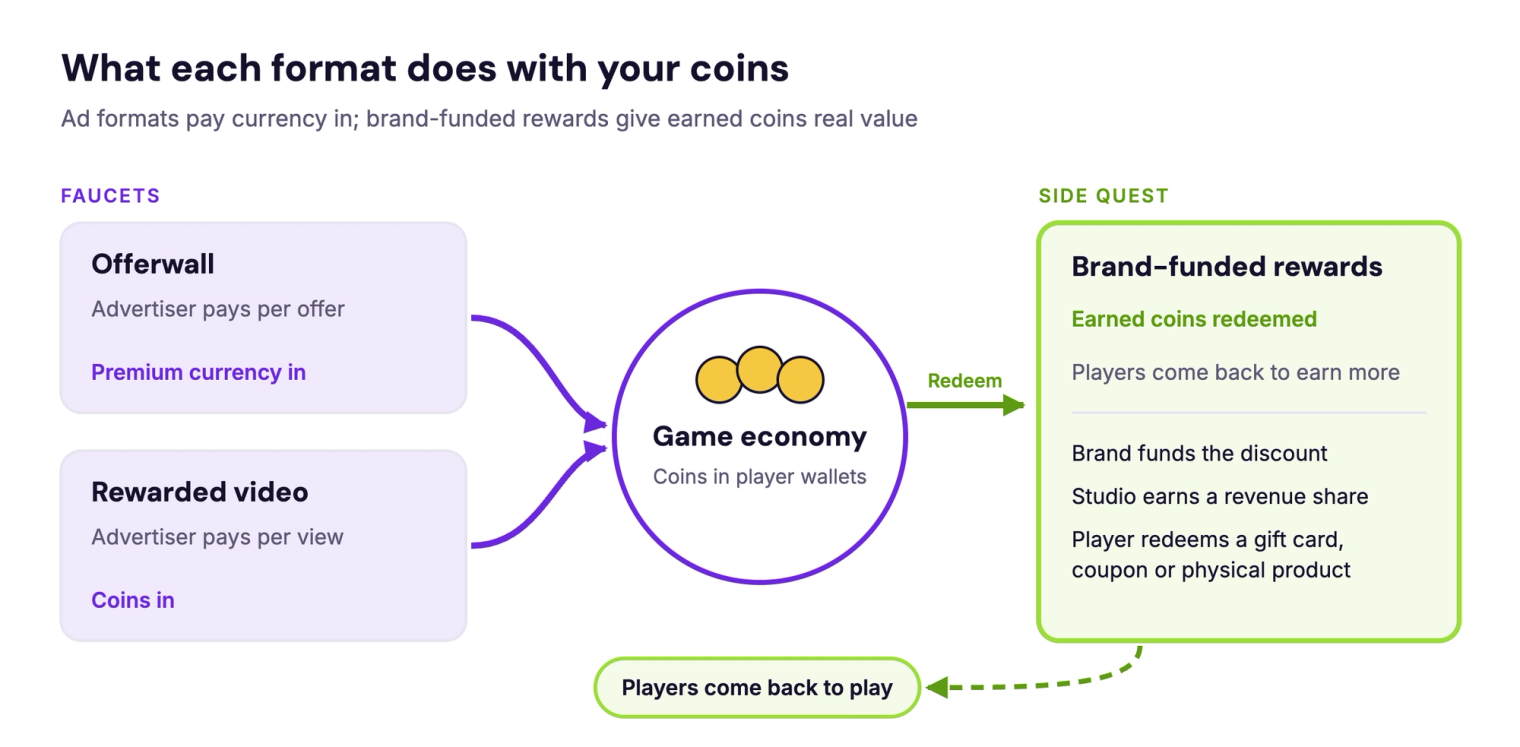
Brand-funded rewards add a reason to keep grinding and a revenue share on each sale, and they leave your balance as it is: players redeem coins already earned, which gives those coins real-life value, at a coin price you set, and no reward pays coins back. Our guide to in-game currency design covers faucets and sinks in more depth.
How strong is the retention evidence for each format?
Most offerwall and rewarded video retention claims compare players who chose to engage with players who did not, while brand-funded rewards have been measured against matched players and holdout groups.
Self-selection flatters the format, because players who engage are already invested. Unity's rewarded ads report defines its engaged group, in a footnote, as players who open the offerwall from the game. Kongregate's study and Tapjoy's research, as PocketGamer.biz reported it, compare engagers with non-engagers in the same way. A player who opens an offerwall on day 10 was likely to be around on day 14 anyway.
We test against comparison groups that did not choose themselves. In Masala Express, 821 matched player pairs at 94% match quality showed D7 retention 5.8 percentage points higher with the rewards, according to its case study. CallBreak rolled two native tiles out to 10% of players and kept 90% as a control. A worked example with those inputs shows why the denominator matters. If 10% of players see the rewards and their ARPDAU rises 52%, the whole base moves by about a tenth of that, or 5.2%, which is what CallBreak reported across its 1M-DAU base. Both numbers are true, and a vendor who quotes only the first is answering a smaller question.
Ask any vendor, us included, three questions before you trust a lift. Who was in the comparison group? How was that group matched? And is the lift measured on every eligible player, or only on those who engaged?
Can a game run all three, and what do ad network rules allow?
A game can run all three if each sits at its own moment and the coins paid for watching ads never become a direct route to a real-world reward, which Google and Unity both restrict.
Google AdMob's policy for rewarded ad units says "Direct monetary items may not be offered as rewards under any circumstance," lists gift cards among them, and caps a voucher for a physical item at 25% of the item's value. Unity's rewarded inventory policy bars publishers from rewarding ad views or offer actions with "any offers of real-world rewards such as cash, prizes, incentives, gift cards, goods, services, vouchers or anything of value". So keep the currency your ads and offerwall pay apart from the coins players redeem for brand rewards, or clear the setup with your ad network before launch.
Timing then keeps the three formats from competing. Rewarded video belongs at moments of need, such as a failed level. Unity recommends showing the offerwall in the store and when a player runs out of currency. Brand-funded rewards fit the high points, after a win or a level-up. Our guide to hybrid monetization shows how these lines sit next to in-app purchases.
When is each format the wrong choice?
Each format is the wrong first choice when it works against your game: offerwalls in hypercasual or iOS-heavy games, rewarded video in an economy with few sinks, and brand-funded rewards when the widest reach this week is the only goal.
Unity says hypercasual games "usually aren't the best fit" for an offerwall, and AppsFlyer's offerwall glossary notes that Apple's rules on incentivized downloads have removed cost-per-engagement offers from iOS offerwalls. Credits are the other risk, because each one depends on the provider's server callback. A developer on the Solar2D forum reported callbacks that came 24 hours late or not at all, so players went unrewarded and the studio went unpaid.
Rewarded video is the wrong first step when your coin packs already struggle. Cap the views and price the reward against your store before you scale it. CrazyGames' rewarded ads guide suggests a simple test: offer a smaller reward, and keep it if players watch just as many ads.
Brand-funded rewards reach fewer players than an ad unit, because they appear only at chosen moments and players open them when they want to, so they are the wrong first choice if reach is all you need this week. In return they bring deals players chose to look at, longer sessions and a view of what your players buy, which ad reports cannot show. Any game can integrate them, at any DAU, before or after launch. Earnings are optimized from 50K DAU in free-to-play or freemium games, because the margins are earned on volume. A game without a soft currency can add one that players earn through simple loops or level-ups.
FAQ
What is the Tapjoy offerwall?
The Tapjoy offerwall is the offerwall Unity now sells as "Tapjoy from Unity": an in-app list of advertiser offers that pays players in-game currency for each one they complete. Unity's migration guide moves ironSource offerwall publishers onto Tapjoy.
Do offerwalls and rewarded video hurt in-app purchases?
They can, when free currency is cheaper to earn than your packs are to buy with real money. Cap rewarded views, set the offerwall exchange rate at your store price and give every new faucet a matching sink before you scale either one.
Who decides what a coin is worth when players redeem brand-funded rewards?
The studio decides. It picks which soft currency to connect and sets each coin's value, which sets the coin price of every reward. Coupons are redeemed with coins only; every product and gift card also offers coins plus cash.
How long does it take to add brand-funded rewards to a game?
Most studios take one touchpoint live in 1 to 2 hours on our self-serve console. We support Unity through the PlaySuper SDK, native Android and iOS through our APIs and WebViews, and web games through a JavaScript SDK. Read more on what gaming commerce is and how brands reach players inside games.
If you want the coins players already earn to keep them grinding, see what your currency could be worth and talk to us about adding brand-funded rewards at your game's best moments.
- Monetisation