Hybrid Monetization for Games: IAP, Ads and a Third Line
Hybrid monetization mixes in-app purchases and ads in one game. Genre data, where each line fits in a session, and a third line open to every player.
Hybrid monetization is a game earning from in-app purchases and ads together, paid for by the few players who spend real money and by advertisers who pay to place ads in it. Brand-funded rewards add a third line that every player can use: players redeem earned coins for products that brands discount, and the studio takes a revenue share.
The question for most studios is which line should lead in their genre, and what a third line adds. In CallBreak, a game with 1M daily players, brand-funded rewards in two lobby tiles raised ARPDAU 52% among the 10% of players who saw them, with no new screens and no new ad load.
What is hybrid monetization, and how common is it?
Hybrid monetization is a free-to-play game running in-app purchases (IAP) and ads side by side, and fewer than 30% of games do it, according to AppsFlyer's 2026 gaming report.
The case for it starts with how few players pay. As a worked example, take a game at 50,000 daily players. At the median payer share of 0.5% in the 2024 Unity Gaming Report, about 250 paying players spend real money on a given day, and 49,750 do not buy anything with real money that day. An IAP-only game earns nothing from that second group. Unity's Game Design & Revenue Consultancy therefore recommends mixing purchases with ads the game shows and ads players choose to watch.
The hybrid monetization model usually stops at two lines. We add a third: brand-funded rewards, a form of gaming commerce where players redeem the coins they earn for gift cards, coupons and physical products that brands discount. We call that revenue line the third wallet, and every player in the game can use it, including players who never spend in-app. Nearly every player has a lifestyle budget, but until now that spend has always lived outside the game.
How do mobile games make money from each kind of player?
Mobile games make money from players who spend real money on purchases, from advertisers, and from brands that fund rewards every coin-holding player can redeem.
| In-app purchases | Ads | Brand-funded rewards | |
|---|---|---|---|
| Who pays | The player, with real money | The advertiser | The brand, through a discount and commission |
| Player gives | Real money | Time watching an ad | Coins earned in play |
| Player gets | Coins, items, passes | Coins or a retry | Gift cards, coupons, products |
| Coins | Adds paid coins | Adds free coins | Gives earned coins real value |
| Shown at | Shop, fail screens | Level breaks, retries | Wins, level-ups, milestones |
| Where it wins | High spend per paying player | Fast payback on installs | Retention, purchase insight |
| Main risk | Few paying players carry revenue | Interrupts play | Needs an earned currency |
Each line earns from a different payer, and the third one also brings players back: redeeming coins is a side quest beside the game loop. The coins row shows why it sits easily beside the other two. Purchases and rewarded ads add coins, while brand-funded rewards let players redeem coins they already earned, at a coin price the studio sets, and no reward pays coins back.
Does hybrid monetization earn more than IAP or ads alone?
On Android it often does. On iOS, midcore games earned more by staying IAP-only, according to AppsFlyer's 2024 monetization report for high-income markets.
Android midcore games on hybrid reached 146% return on ad spend by day 90, compared with 93% for IAP only and 58% for ads only. On iOS, midcore games on IAP models reached 215% ROAS, while hybrid models managed 73%. For hypercasual games, hybrid lifted revenue per player by day 90 by 28% over ads alone.
Tiffany Keller, Director of Product at GameForge AI, gives the rule behind the split in that report: "The name of the hybrid game is slightly less ad friction than other games your audience plays." Her named exceptions are casual hits that win by "marketing based on their lack of ads in-game (like Royal Match by Dream Games or Match Factory by Peak Games)." For most studios, the practical reading is to test hybrid per platform and to keep ad load below what players meet in the games they would switch to.
Which mix fits your genre?
Casual and hypercasual games already run both lines more often than other genres, at 33% and 32%, while 15% of midcore games do, per AppsFlyer's 2026 gaming report.
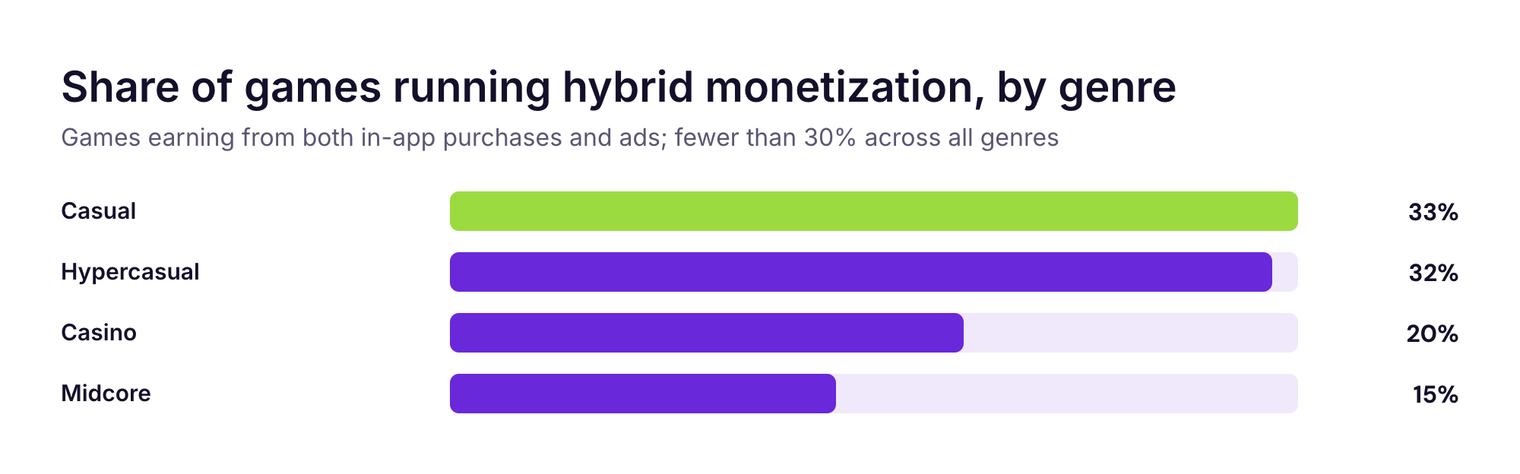
Revenue per player explains the gap. AppsFlyer's 2026 monetization report puts a casual player's first 90 days at $1.34 from purchases and $0.55 from ads, against $2.13 and $0.40 for a midcore player. As a worked example, a game earning both genre averages would get 29% of a casual player's 90-day revenue from ads but only 16% of a midcore player's.
So the lead line follows the genre. Casual games can run both from launch, starting with rewarded ads. Midcore games should lead with purchases and treat ads as a small extra. Hypercasual games lead with ads, since they earn 63% of their day 60 ad revenue on day 1, per the same AppsFlyer report, and add small offers for the players who stay. Brand-funded rewards fit any of the three once the game has a currency players earn, which our guide to in-game currency design covers.
How do you keep rewarded ads from eating coin pack sales?
Cap what rewarded ads pay so coin packs keep their value, and match every new faucet with a sink in the game.
Unity's consultancy puts rewarded ads first in the order: "The Unity Game Design & Revenue Consultancy recommends first implementing rewarded ads before looking to include system-initiated ads." To protect purchases, it adds, "reward values are carefully calibrated." In practice, if one ad pays close to what a small coin pack sells, buyers notice and stop buying.
The other half is the sink. Daniel Godley's game economy guide for Unity gives the rule: "Audit every faucet against a matching sink before shipping it." Our comparison of offerwalls, rewarded video and brand-funded rewards covers the trade-offs in detail.
When in a session should players see each line?
Players should see purchase prompts when they want progress, interstitials at natural breaks, rewarded ads when they face a choice, and brand-funded rewards straight after a win, a level-up or a milestone.
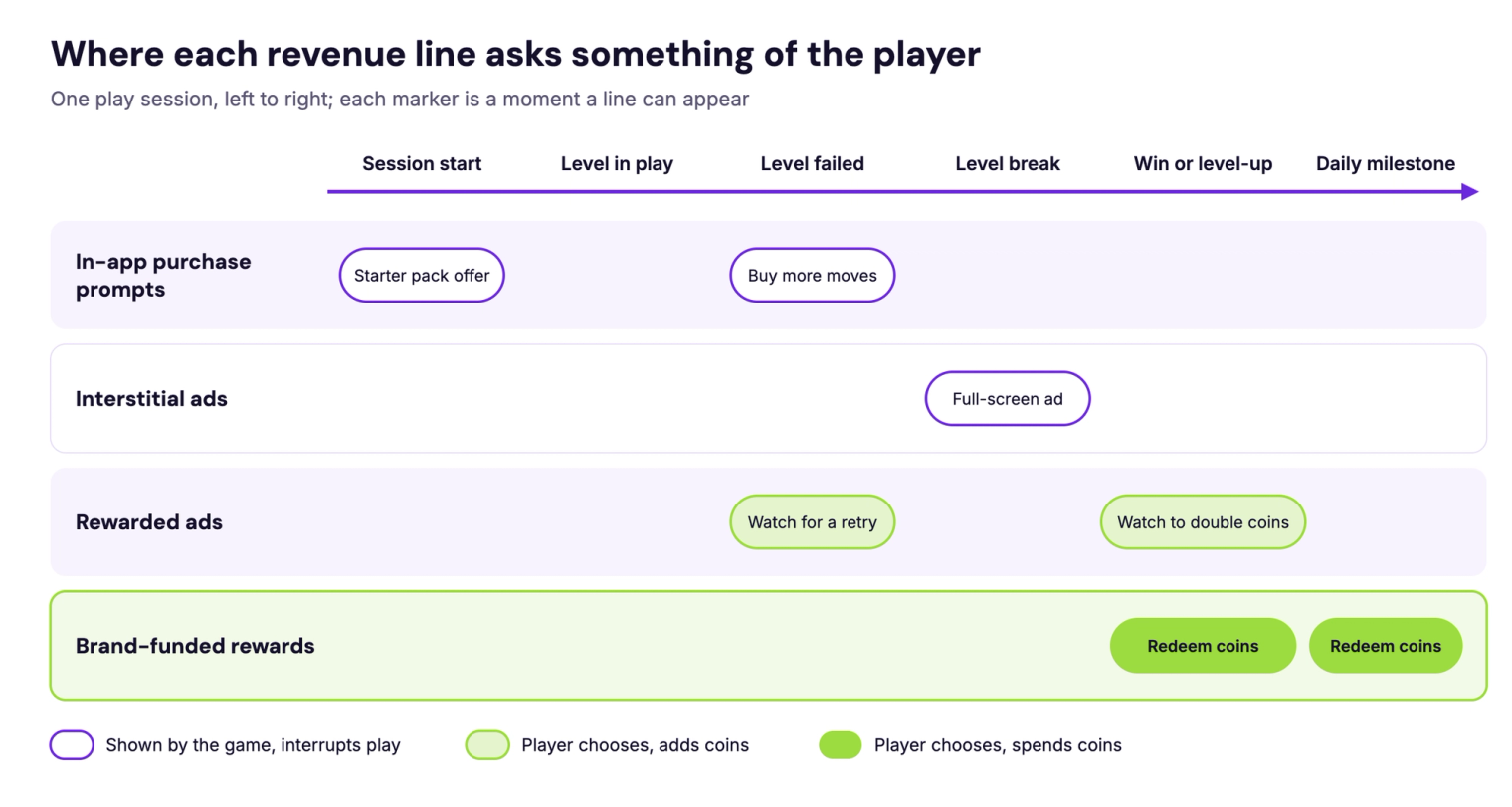
Interstitials and purchase prompts stop play, and too many of them lose players, so Unity's consultancy says system-initiated ads "should also complement, not interrupt, the existing core gameplay loop." Rewarded ads wait for the player to opt in. Brand-funded rewards go one step further and sit at the game's high-engagement, high-dopamine moments, when the player has coins in hand and a reason to redeem them.
Masala Express, a casual cooking game, measured what that does across 821 matched player pairs. Day 7 retention rose 5.8 percentage points, the coin earn rate rose 42%, and both game opens and days active rose 10%. Redeeming works as a side quest: once coins have real-life value, players grind for more of them and come back to the game to earn them, and the studio earns additional revenue on each redemption.
Who funds the third line, and what does the studio get?
Brands fund it: each brand sets a discount on its own product, earned coins cover part of the price, and the brand pays us a commission on every sale.
The studio never pays us. We pay the studio a revenue share of 40% to 70% of the profit, set by the game's daily active players. Players redeem across 3,000+ brands, from physical products to popular lifestyle and gaming gift cards, and physical rewards ship across the US and India. Coupons are redeemed with coins only; every product and gift card also offers coins plus cash.
The third line also returns data that ads and purchases do not. Ad and conversion numbers are split across networks today. Because we run the studio side and the brand side, the studio gets one funnel from touchpoint to view, redemption, order and delivery, plus a view of which brands its players prefer.
How do you measure whether a new line adds revenue?
Measure it with a random holdout, read the result at a date late enough for purchases to land, and scale it from the exposed group to the whole game.
Random assignment comes first, because players who choose a feature were often going to stay anyway, and comparing them with players who ignored it overstates the effect. CallBreak's 10% and 90% split avoids that problem.
The date matters next, because ads mature fastest. By day 7, in-app advertising has generated 89% of its day 60 revenue but purchases only 60%, per AppsFlyer's 2026 monetization report, so an early readout favors a new ad placement over the purchases it might displace.
Scaling comes last. In CallBreak, a 52% lift on 10% of players is a 5.2% lift on the game. Run the same check on any vendor's pilot, because a pitch that quotes only the lift for exposed players has told you half the result.
When is a third line the wrong next step?
Hold off if your only target this quarter is the fastest payback on paid installs, because ads return most of their revenue within the first week and brand-funded rewards build value over longer play.
What waiting gives up: retention, and a view of what players redeem and which brands they prefer, which ad and IAP reports do not show. The PlaySuper SDK leaves ad optimization and IAP flows as they are, so it can be added at any point.
Two other cases look like blockers and are not. A game without a soft currency can create one that players earn through simple loops, level-ups or a bonus on each visit. Real-money games that hold a wallet for their players can hand out brand rewards instead of paying cash out directly. Any game can integrate the SDK, at any DAU, before or after launch. Earnings are optimized from 50K DAU in free-to-play or freemium games, because the margins are earned on volume.
FAQ
How do free games make money?
From the few players who buy with real money, and from advertisers who pay to reach everyone else. Some games add a third line, brand-funded rewards, which brands pay for through discounts players redeem with coins.
Does adding ads reduce in-app purchases?
Adding ads reduces purchases when rewarded ads hand out the coins that coin packs sell. Keep each ad reward well below a coin pack's value, keep some items purchase-only, and test placements on a small group against a control group before rolling them out.
Can a rewarded ad pay players in gift cards?
No. Google AdMob's policy bars direct monetary items such as cash, cryptocurrency and gift cards as ad rewards, and Unity's rewarded inventory policy bars real-world rewards for viewing an ad. Brand-funded rewards are redeemed with coins earned in play, and the brand's discount pays for them. Keep the currency your ads pay apart from the coins players redeem, or clear the setup with your ad network first.
How fast can a studio add brand-funded rewards to a live game?
The time depends on how many touchpoints a studio adds, because each one is a placement inside the existing game rather than a new economy. With the PlaySuper SDK, one touchpoint takes 1 to 2 hours to go live on our self-serve console.
Who decides what a coin is worth when players redeem rewards?
The studio should decide, because the coin's value shapes the whole economy. With the PlaySuper SDK, the studio picks which soft currency to connect and sets the value of each coin, which sets how many coins each reward costs.
See what your in-game currency could earn as a third line on Your Currency Potential.
- Monetisation