How Do Free Games Make Money? Data on the US Top 100 (2026)
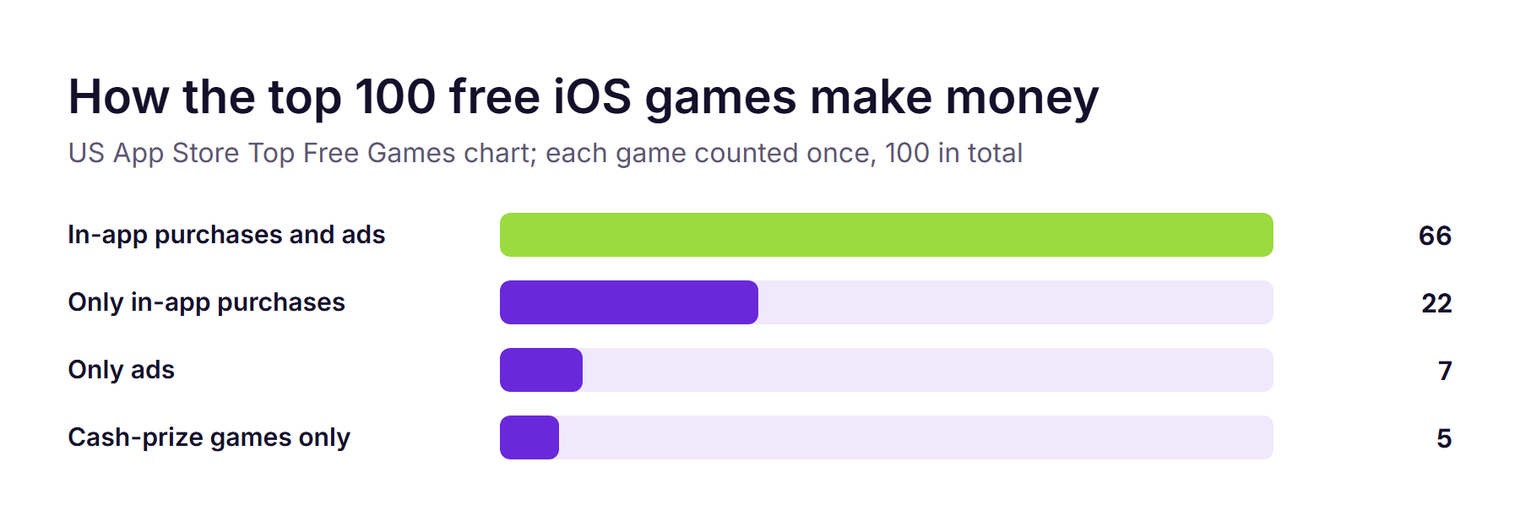
Free games make money mostly by selling in-app purchases and showing ads, and most of the biggest run both. In Apple's US top free games chart of 18 November 2026, 88 of the 100 games sell in-app purchases, 73 show a public sign of ads and 66 do both.
The top 100 free games make money from two of three possible wallets: players paying real money for in-app purchases, and advertisers paying for ads. In Apple's US Top Free Games chart for iOS on 18 November 2026, 88 games sell in-app purchases, 73 show a public sign of ads, 66 run both and 34 sell ad removal.
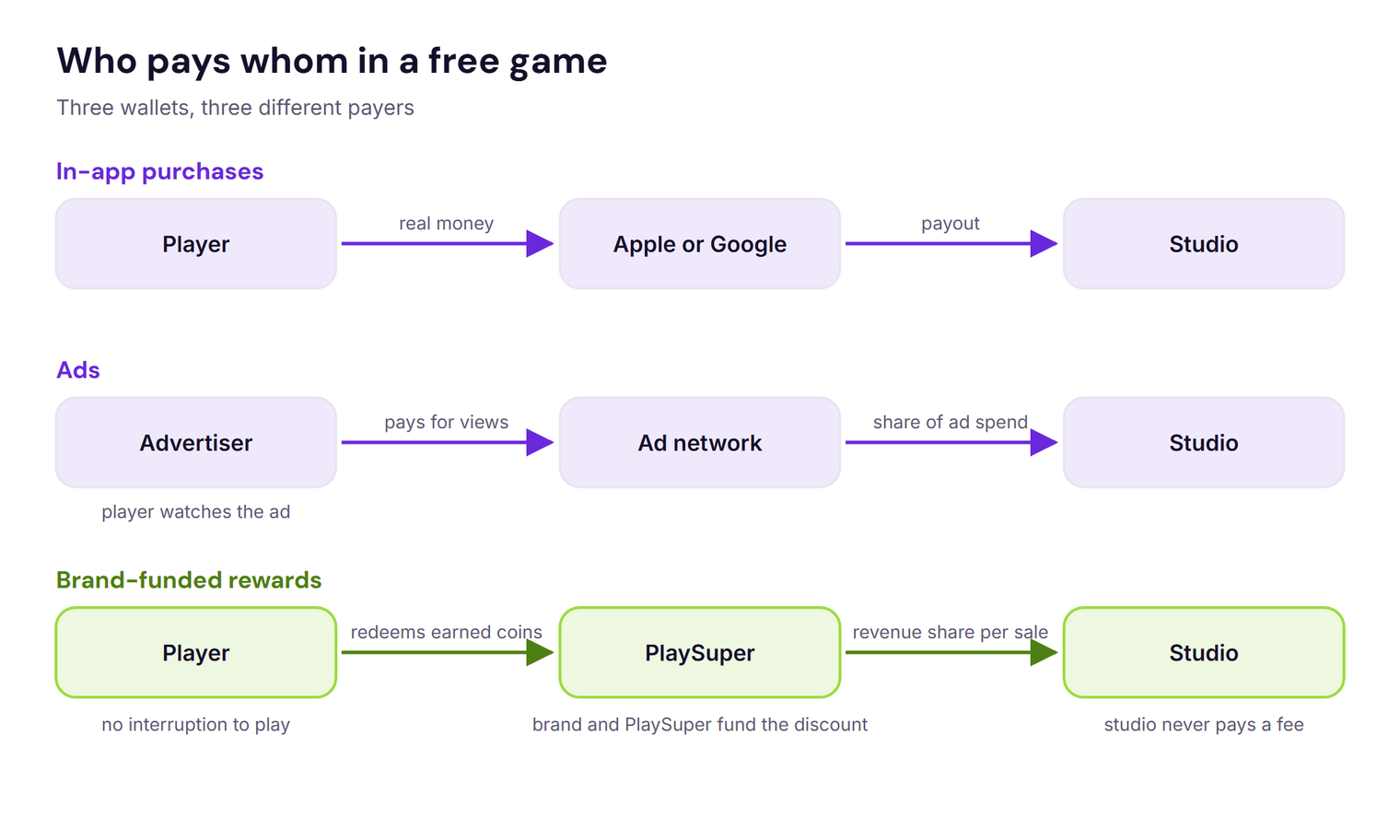
Choose your next revenue line based on who pays for it: players paying real money through Apple or Google, advertisers paying an ad network for views, or brands, through PlaySuper's brand-funded rewards, when players redeem coins earned in play.
Method: PlaySuper read the public App Store and Google Play listings of all 100 games in Apple's US Top Free Games chart for iOS, as published on 18 November 2026, and classified each game's revenue lines from what the listings show. The chart changes daily, so the counts describe that day's chart.
Key takeaways
- Top free games such as Block Out!, Roblox and Chess.com charge players real money through Apple or Google and sell advertisers ad views in the same game.
- In-app purchase lists for chart games are made up of currency packs, bundles, passes and fail offers such as Candy Crush Saga's Extra Moves.
- Apple's age-rating Advertising label misses games that Google Play marks "Contains ads", so check both stores' labels and the ad-removal purchases when benchmarking ad load.
- Puzzle, word and casual hits show ads beside their purchases, while strategy hits such as Whiteout Survival and Kingshot sell passes and show no ads.
- Ad removal sold as an in-app purchase turns an ad viewer into a payer, but the studio loses that player's ad revenue.
- App Store and Google Play listings do not show offerwalls, product placement or brand deals, so brand-funded revenue never appears in a store benchmark.
- PlaySuper's brand-funded rewards add a third wallet, where every player can redeem coins earned in play for brand products and the studio earns a revenue share.
Which revenue lines do the top 100 free games use?
The top 100 free games earn from the player's wallet, through in-app purchases paid in real money through Apple or Google, and from the advertiser's wallet, through ads an advertiser pays an ad network for. In Apple's US Top Free Games chart, 66 of the 100 games do both, 22 sell only in-app purchases and 7 show only ads. The other 5 are cash-prize games, which earn from real-money cash matches rather than from in-app purchases or ads.
The top 10 lean the same way. Seven of them run both lines, among them Meowdoku!, Block Out!, Chess.com and Roblox. The other three, Fortnite, Block Blast! and Township, sell in-app purchases and show no sign of ads.
Across the chart, 90% of the games that show ads (66 of 73) also sell in-app purchases.
In this study, a public sign of ads means any of three things on a listing: Apple's age-rating Advertising declaration, Google Play's "Contains ads" label or an in-app purchase that removes ads. The 100 games come from 76 developers; Oakever Games and Moon Active each have 4 titles.
The third wallet belongs to brands. With PlaySuper's brand-funded rewards, players redeem the coins they earn in play for coupons, gift cards and products from our 3,000+ brands, with the brand and PlaySuper funding the discount. The brand pays us a commission on each sale and the studio earns a revenue share, so the studio never pays us. Store listings do not show brand deals, so this line cannot appear in a count built from App Store and Google Play data like the chart above.
What do top free games sell as in-app purchases?
Top free games sell currency packs, bundles, passes and fail offers, and the median listed item costs $6.99. The App Store shows up to ten purchases per listing, and the 88 games with purchases list 808 priced items between them, 45% of them at $4.99 or less.
Currency packs appear in 49 games, where the player pays real money for a currency spent inside the game. Fortnite's listing runs from "100 V-Bucks" to "12,500 V-Bucks", and Pokémon GO sells "100 PokéCoins" and up.
Fail offers appear in 13 games and are priced for the moment a player loses a level. Candy Crush Saga (King) sells "Extra Moves" at $0.99 and Bus Traffic Fever! sells a "Fail Offer" at $5.99.
The expensive end belongs to strategy, casino and action games. Sixteen games list an item at $99.99 or more:
- 7 in Strategy, including Whiteout Survival, Kingshot and Top Lords
- 3 in Casino and 3 in Action, among them PUBG MOBILE and Call of Duty: Mobile
- 1 each in Board, Word and Role-playing
A deeper price ladder raises what paying players spend; it earns nothing from a player who never opens the shop.
How many top free games show ads, and why do Apple and Google disagree?
At least 73 of the top 100 free games show a public sign of ads, but Apple's Advertising label appears on only 34 listings, a separate count from the 34 games that sell ad removal. Apple's age rating reference defines advertising as "Paid promotion of products or services within the app," and the App Store shows the declaration as "Contains: Advertising" under the age rating.
Google Play tells developers they "must declare whether your app contains ads," and the "Contains ads" label appears on 63 of the 85 chart games with a matching Google Play listing; the other 15 have no match there. Of those 85, 35 carry Google's label without Apple's declaration, among them Meowdoku!, Magic Sort! and Roblox.
Fifteen games sell ad removal without Apple's declaration, including Sudoku.com (Easybrain), whose only listed purchase is "Sudoku.com No Ads" at $14.99, and Among Us! (InnerSloth), which sells "Remove All Ads" at $1.99. If you benchmark your ad load against the chart, read both stores and the purchase list, because Apple's label alone misses more than half of the games with ads.
Which genres rely on ads?
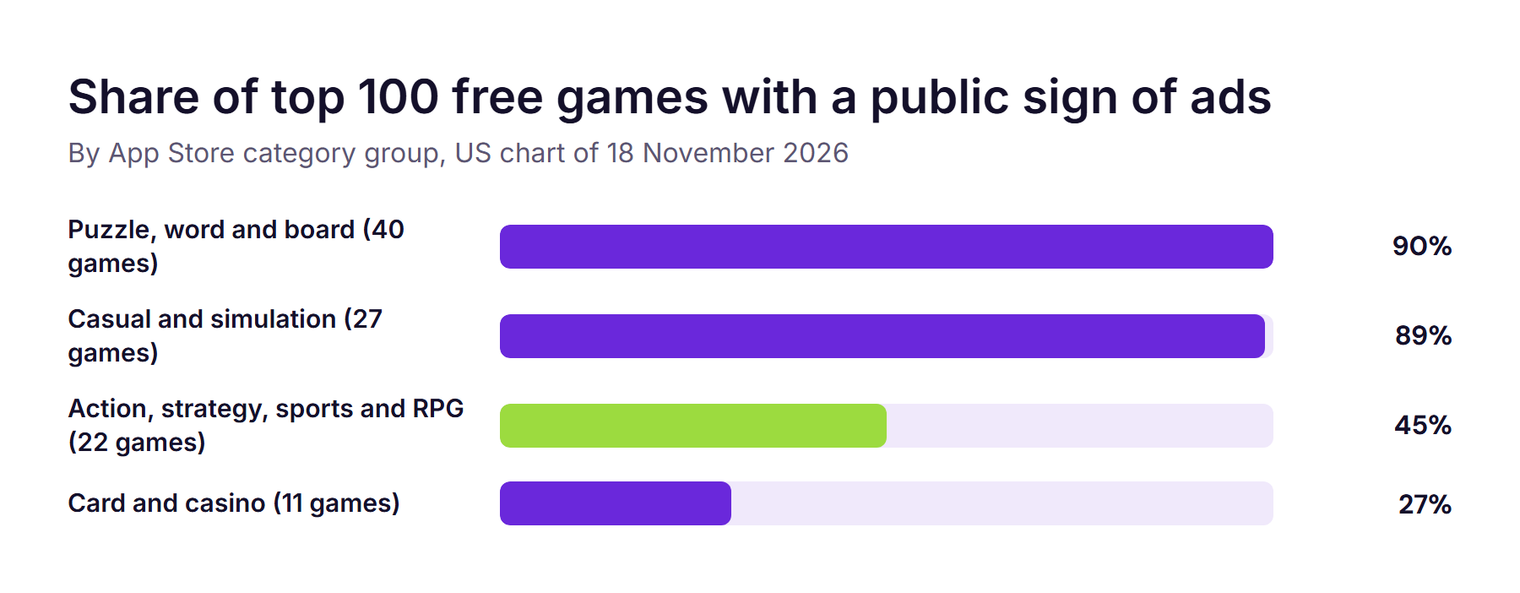
Puzzle, word and casual games rely on ads, and fewer than half of action and strategy games show them. About 9 in 10 puzzle, word, board, casual and simulation games show ads. The share falls to under half of action, strategy, sports and RPG games and about a quarter of card and casino games, as the chart below shows.
Of the 22 games that sell only in-app purchases, 11 sit in the action, strategy, sports and RPG group, among them Fortnite and Whiteout Survival. Only 3 sit in the puzzle, word and board group: Block Blast!, MONOPOLY GO! and Royal Kingdom (Dream Games).
Why do top free games sell ad removal?
Ad removal lets a player pay real money to stop seeing ads: 34 of the top 100 free games sell an ad-removal purchase that removes or skips ads, which is 47% of the 73 games with a sign of ads. The 51 priced ad-removal items have a median of $9.99.
Studios sell it once or by the month. One-off purchases include Paper.io 2's "No Ads" at $9.99 and Mob Control's at $2.99, while Arrows (Lessmore) lists "Remove Ads (1 Month)" at $9.99 up to "Remove Ads (6 Months)" at $39.99.
The player pays real money, and the advertiser stops paying for that player's views. If you already show as many ads as you dare, ad removal turns an ad viewer into a payer, but you lose that player's ad revenue.
Are passes and subscriptions common in top free games?
Passes and subscriptions appear in 35 of the top 100 free games: 21 list a pass and 20 list a subscription, membership or VIP plan (6 list both). The 24 pass items with a listed price have a median of $8.49, from $0.99 to $24.99.
Passes sell across genres. Block Out! sells "Block Pass 10" at $9.99, Royal Kingdom sells "Kingdom Pass" at $9.99, Century Games prices "Regular Pass" at $4.99 in both Whiteout Survival and Kingshot, and Castle Busters sells a "Battle Pass" at $14.99. The subscription and membership plans include Fortnite's "Fortnite Crew" at $11.99, while Roblox sells "Roblox Premium 1000 One Month" at $9.99.
Half of the action, strategy, sports and RPG games list a pass or subscription, the highest share of the four genre groups. A pass earns again each season from the same paying players, so it deepens the purchase line without widening it.
What do App Store and Google Play listings not show?
Store listings do not show offerwalls, product placement, brand deals or revenue, so a benchmark built from them misses every revenue line that sits outside purchases and ads. Google tells developers that its "Contains ads" label "isn't meant to cover whether an app contains other kinds of commercial content, like paid product placement or offers to make in-app purchases or upgrades."
Cash-prize games earn outside the purchase list altogether. Seven chart games list no in-app purchases and describe cash matches, cash prizes or cash-outs: Solitaire Cash and Bubble Cash (Papaya Gaming), Mahjong Clash and Mahjong Rumble (Aviagames), Triumph Arcade, Packz and Pullz. Players deposit real money outside the store, through PayPal or Apple Pay in Solitaire Cash's case, and play cash matches for prizes. Two of the seven also show a public sign of ads; the other five are the games that show neither in-app purchases nor ads.
Which revenue line fits which game?
Purchases fit heavy spenders, ads fit short puzzle and casual sessions, passes fit daily play, cash matches fit skill games for adults, and brand-funded rewards fit any game whose players earn coins.
| Wallet | Revenue line | Who pays, with what | Top 100 | Chart examples | Where it wins | Main risk |
|---|---|---|---|---|---|---|
| Player | In-app purchases, all types | Player, real money via the store | 88 of 100 | Fortnite, Township | Strategy and casino spenders | Paying players only |
| Player | Passes and subscriptions (in-app) | Player, each season or month | 35 of 100 | Royal Kingdom, Roblox | Daily play, long seasons | Returning payers only |
| Player | Ad removal (in-app) | Player, real money | 34 of 100 | Sudoku.com, Paper.io 2 | Players who dislike ads | Lost ad views |
| Player | Cash matches | Player, deposits outside the store | 7 of 100 | Solitaire Cash, Bubble Cash | Adult skill players | Adults only |
| Advertiser | Ads | Advertiser, via ad network | 73 of 100 | Block Out!, Candy Crush Saga | Puzzle and casual sessions | Interrupts play |
| Brand | PlaySuper's brand-funded rewards | Brand and PlaySuper fund the discount | Not on listings | Not visible in store data | Every player, no interruption | Needs an earned currency |
Every line in the player and advertiser wallets charges the player real money or interrupts play. If you run a puzzle or casual game, keep your ads and ad removal, then add a line that reaches the players who never buy.
How can a free game earn from every player without more ads?
A free game earns from every player without more ads when players can redeem the coins they earn in play for real products from brands, which opens a third wallet beside purchases and ads. Nearly every player has a lifestyle budget, and that spend has always lived outside the game.
PlaySuper's brand-funded rewards bring that spend inside. A player redeems earned coins for a coupon, gift card or product from one of our 3,000+ brands, and the brand and PlaySuper fund the discount that lets coins cover the price, or part of it with the player paying the rest. The brand pays us a commission on every sale, and we pay the studio a 40% to 70% revenue share, set by DAU. The studio never pays us.
Redeeming is a side quest placed after a win or a level-up. In Masala Express, measured against 821 matched player pairs, D7 retention rose 5.8 percentage points and the coin earn rate rose 42%. The 49 chart games that sell currency packs already run a coin economy, and many hold bought and earned coins in one wallet. Only coins earned in play connect to the PlaySuper store, so a game that mixes the two separates its earned coins before adding rewards.
What does it take to add brand-funded rewards?
Adding brand-funded rewards takes three things: a currency players earn, an integration and a coin price for each reward.
- An earned currency: coins or another currency players earn by playing, such as coins for a finished level.
- An integration: the Unity SDK for Unity games, our APIs and WebViews for native Android and iOS games, or the JavaScript SDK for web games, with one touchpoint usually live in 1 to 2 hours on our self-serve console.
- A coin price: the value the studio sets for each coin on redemption, along with where each touchpoint sits.
Games of any size can integrate, including games that have not launched yet.
When are brand-funded rewards the wrong fit?
Brand-funded rewards are the wrong first move if you need revenue this week from a game with very little traffic, because brand margins are earned on volume and the PlaySuper SDK works best for studios with at least 50K DAU. A smaller or pre-launch game can still integrate now and gain a reason for players to return.
A game with no earned currency is a poor fit until it adds one.
FAQ
Which top free games show no ads?
Twenty-two chart games sell only in-app purchases, among them Fortnite, Township, MONOPOLY GO!, Royal Kingdom, Pokémon GO and Gardenscapes.
How much does ad removal cost in top free games?
The median listed ad-removal item costs $9.99. Prices run from Among Us!'s "Remove All Ads" at $1.99 to Arrows' "Remove Ads (6 Months)" at $39.99.
Do cash prize games sell in-app purchases?
No. The seven cash-prize games in the chart, such as Solitaire Cash and Bubble Cash, list no in-app purchases on the App Store and earn from real-money deposits for cash matches instead.
Does the studio pay PlaySuper?
No. Brands pay us a commission on every sale, and we pay the studio a 40% to 70% revenue share, depending on DAU.
Studio teams: in our CallBreak case study, two native store tiles went to 10% of players against a 90% control group, and ARPDAU rose 52% for the players who saw them.
- Reports
- Monetisation