
How does advertising in video games work? Placement, ads and commerce
Three ways a brand gets inside a mobile game: placement, in-game ads and brand-funded rewards. How each is bought and measured, and when to pick it.
Advertising in video games works in three ways. A brand can be built into the game world as a placement, buy ad slots that the game serves, or fund real rewards that players redeem with coins they earned. Each route is bought, counted and priced differently, and each suits a different campaign goal.
Pick the route by the goal: in-game ads for reach, a placement for a remembered moment, rewarded or click-enabled ads for clicks and installs, and brand-funded rewards for a product in a player's hands. The reasons are in the comparison and the decision diagram further down.
What are the three ways a brand can be inside a game?
Placement, in-game ads and brand-funded commerce each put the brand in a different place and ask something different of the player.
With placement, the studio builds the brand into the game under a deal, as a branded car, say, or a real shop on the map. In-game ads come from an ad server instead. Interstitial and rewarded ads take over the screen at a break, while intrinsic ads sit on surfaces inside the game world and play carries on around them. With commerce, the brand's product becomes the reward: the player pays in coins earned by playing, and the brand pays for the product. PlaySuper runs this route as an in-game rewards store.
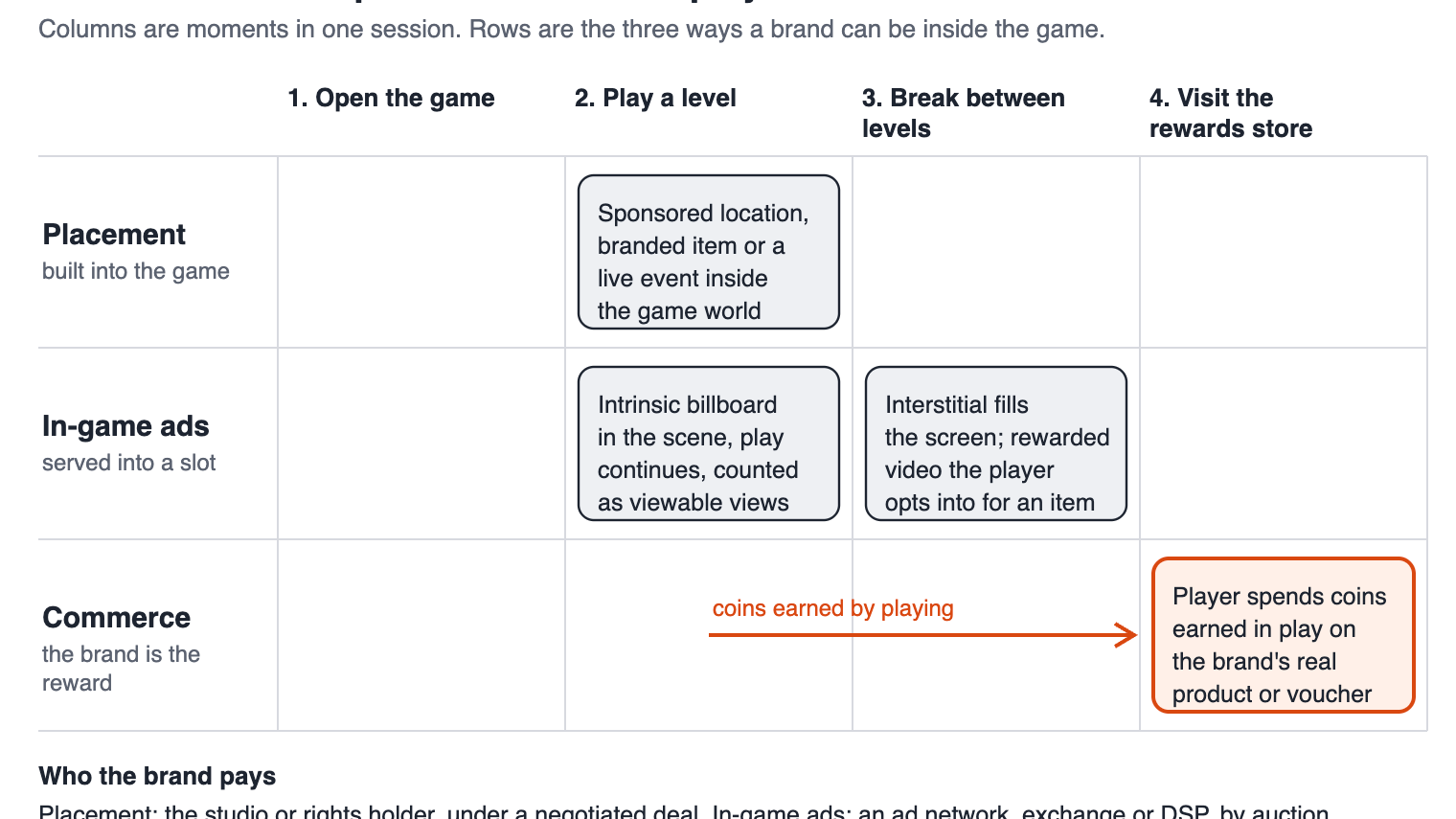
The line between a placement and an intrinsic ad decides how a campaign gets counted. The IAB and Media Rating Council's measurement guidelines (IIG 2.0) cover in-game placements "served by an ad server with a corresponding ad session". They say "hard-coded In-Game branded elements that are integrated into a video game design are not intended to be directly applicable". So an ad server can count a served billboard, but a car built into the game needs a measurement plan of its own.
How does product placement in a game work?
A placement is agreed game by game, under a deal that fixes what goes in, for how long and how it gets reported. The brand usually buys an item, a place or an event.
An item is something the player actually uses. In 2014 Mercedes-Benz sponsored three drivable cars as free downloadable content for Nintendo's Mario Kart 8. Caroline Pilz, who ran product placement for Mercedes-Benz Cars, told Fortune the brand had learned that "many gamers are skeptical about brands appearing in their games". So the item has to earn its place in the game.
Places are the clearest mobile case. In December 2016 Starbucks turned 7,800 company-run US stores into gyms and PokéStops in Pokémon GO, according to TechCrunch's report on the deal. Players got a reason to walk into the shop.
Events, such as a branded level, are built for one game and priced as one-offs.
Whichever you buy, write the reporting into the deal. Ask for players exposed, time spent with the item and how often it was used, store visits where there is a real location, and a brand lift study if the budget allows.
There is no public price list for placement. The one published rate we found is Niantic's: in 2017 a spokesperson told TechCrunch that its "cost per visit (CPV) model visit has partners spending less than $.50 / daily unique visit to sponsored locations". That was one game charging for foot traffic, so expect every other deal to be quoted from scratch.
How do in-game ads work: interstitial, rewarded and intrinsic?
In-game ads are bought like other digital media, through ad networks, exchanges and demand-side platforms (DSPs), and counted by the impression. The formats differ on whether play stops and whether the player chose to see the ad. Prices are set at auction, and we found no public rate card from Google or Anzu.
Interstitial ads
Interstitials fill the screen at a pause. The IAB and MRC guidelines leave them out of scope but describe them as "full-screen ads that cover the interface of their host app", placed "at natural transition points or breaks, such as in between activities or game levels". Every player who reaches the break sees one, and play stops while they do.
Rewarded ads
A rewarded ad is one the player asks for. Google's AdMob help pages define them as ad units that "reward users with in-app items for interacting with video ads, playable ads, and surveys", served "after a user explicitly chooses to view a rewarded ad". Google also limits what the reward can be. Its policy for ad units that offer rewards says "direct monetary items may not be offered as rewards under any circumstance", names cash, cryptocurrency and gift cards as examples, and caps vouchers for physical items at 25% of the item's value.
Intrinsic ads
Intrinsic ads sit on surfaces inside the game world, a trackside billboard for example, while play carries on. Under the IAB and MRC guidelines, a display ad in a game counts as a viewable impression when at least 50% of its pixels are on screen for at least one continuous second and the visible part covers at least 1.5% of the screen. Video needs 2 continuous seconds, and the guidelines recommend not counting an ad turned more than 55 degrees away on any one axis. That is where they stop. They do not cover "interaction attributes, engagement and outcomes", so recall and sales need a study of their own.
Intrinsic ads have started to take clicks. In a February 2026 announcement, the intrinsic ad platform Anzu launched click-enabled ads for "performance DSPs", using double-tap and tap-and-hold gestures so players do not click by accident. If you buy intrinsic, ask the vendor whether your slot can take a click.
How does in-game commerce work when a brand funds the reward?
The player earns coins by playing, opens a rewards store inside the game and spends the coins on the brand's real product: a gift card, a discount code or a physical item. The brand pays for the product, and nothing interrupts play.
That AdMob policy is the reason commerce counts as a route of its own. A rewarded ad cannot pay out a gift card. Commerce hands over a real product, and the player pays for it with coins they already hold. PlaySuper calls the category gaming commerce.
PLAYSTUDIOS runs the best-documented program, because it reports to the SEC. In its first-quarter 2026 results, the company says its myVIP platform lets players of its games "earn real-world rewards from a global collection of iconic hospitality, entertainment, and leisure brands". In that quarter, players "purchased approximately 169,000 rewards with a retail value of $15 million through the playAWARDS platform". The second-quarter results show reward purchases down 15.6% on a year earlier. That is one publisher, so it proves the mechanism runs at scale and tells you little about results anywhere else.
Mistplay is building the same route. Its January 2026 announcement says it agreed to buy Mobivity's Connected Rewards platform, which links mobile games to brands "by enabling consumers to earn real-world brand offers and rewards through gameplay".
To buy this route, a brand works with the rewards platform or the studio, sets the offer and its coin price, and funds the stock. What gets counted is concrete (offers seen, redemptions, codes used later), though no industry standard governs those counts yet. No vendor we checked publishes a price list for brand-funded rewards, PlaySuper included.
How do placement, ads and commerce compare?
The routes differ most in who counts the results and what the player has to do.
Placement
- Where the brand appears: Built into the game: item, location, event
- Does play stop?: No
- Player's choice: None; some ask the player to use the item
- How it is bought: Deal with the studio
- Measurement standard: Outside IIG 2.0; custom reports
- Public price: None; one example: Niantic, under $0.50 per daily unique visit (2017), per TechCrunch
- Where it wins: Memorable; can drive foot traffic
- Where it is weaker: Slow, one game at a time; players can resent it, as Mercedes-Benz found
Interstitial and rewarded ads
- Where the brand appears: Full screen, at a break
- Does play stop?: Yes
- Player's choice: Interstitial: none. Rewarded: opt-in
- How it is bought: Networks, exchanges, DSPs; auction
- Measurement standard: IAB and MRC in-app rules
- Public price: None; auction
- Where it wins: Scale and speed
- Where it is weaker: Interrupts play; AdMob policy bars cash, crypto and gift cards as rewards and caps vouchers at 25% of the item's value
Intrinsic ads
- Where the brand appears: On surfaces in the scene
- Does play stop?: No
- Player's choice: None
- How it is bought: Intrinsic platforms, DSPs
- Measurement standard: IIG 2.0 viewability
- Public price: None; auction
- Where it wins: Reach without stopping play
- Where it is weaker: Glanced at; outcomes need a separate study
Commerce (brand-funded rewards)
- Where the brand appears: A rewards store the player opens
- Does play stop?: No
- Player's choice: Picks the product, spends coins
- How it is bought: Via the rewards platform or studio; brand funds stock
- Measurement standard: None; offers, redemptions, codes
- Public price: None
- Where it wins: Product in hand; each redemption is a choice
- Where it is weaker: Smaller reach; needs games with an earned currency; physical rewards from PlaySuper ship within India only
For reach, ads win easily and commerce is nowhere close. For a product in a player's hands, or proof that a player picked your brand, it goes the other way. An ad can show your product, but a redemption means the player chose it and now has it. Placement buys the moment people remember, and it takes the most work to set up.
Which route should you pick for your campaign goal?
Start from what the campaign has to deliver, then pick the route that can count it.
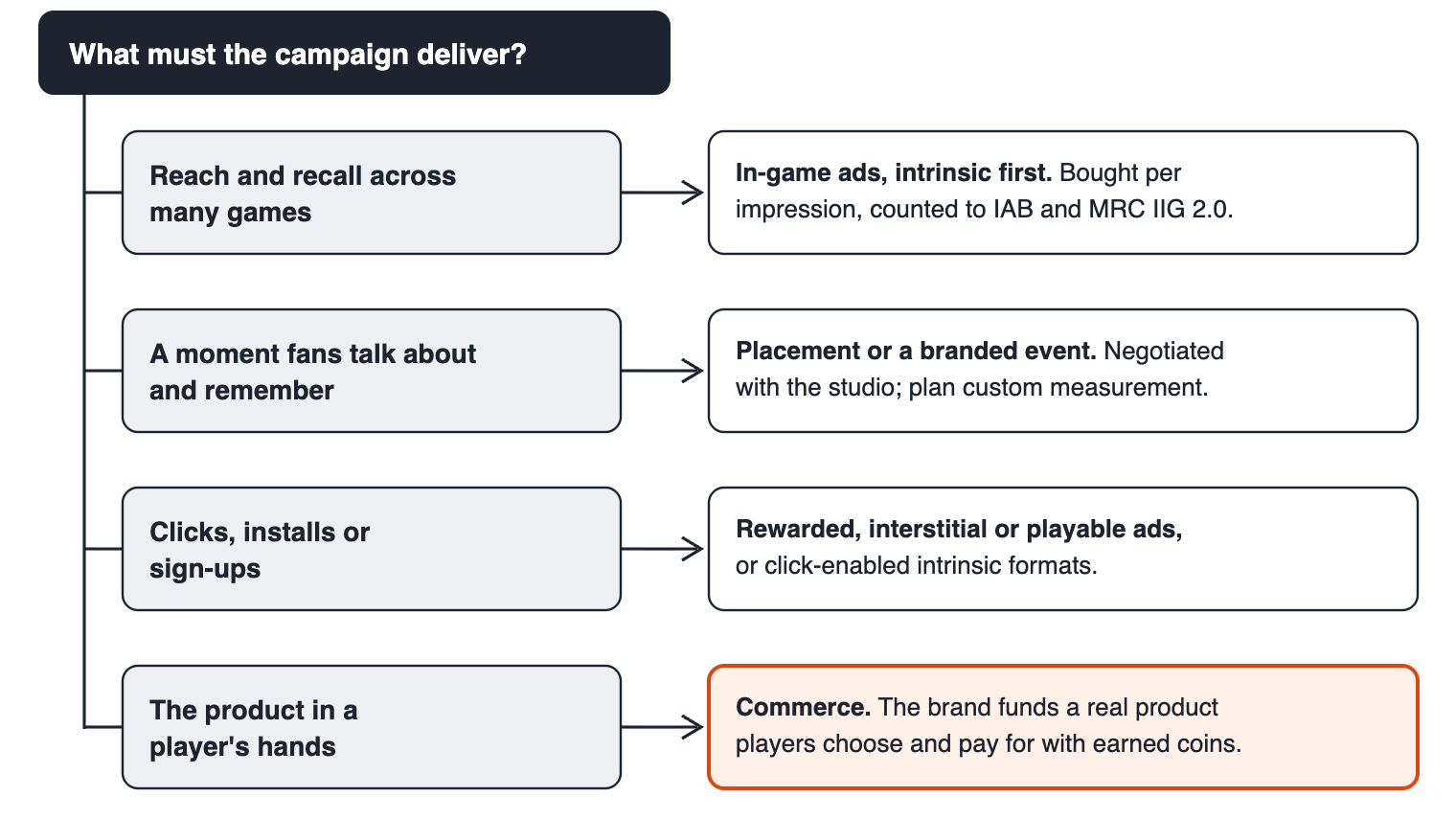
If you need reach and recall across many games, buy in-game ads. Go intrinsic first, because it does not stop play, and budget separately for a brand lift study.
A moment fans talk about takes a placement or a branded event, commissioned from one studio. Plan for a long lead time.
Clicks, installs and sign-ups are what rewarded, interstitial, playable and click-enabled intrinsic ads are built for. Judge them on cost per action.
To put the product in a player's hands, fund rewards in a store. It suits a product people value once they have tried it, or one where a code lets you trace the sale.
Before you sign for any route, run three checks. Get the definition of an exposure or a redemption in writing. Ask which countries the route reaches. And find out whether the game's audience includes children under 13, because in the US the FTC's COPPA rule puts requirements on online services "directed to children under 13 years of age".
You can also combine routes. An intrinsic billboard can carry the offer that sits in the rewards store. Test that against a holdout group before you scale it.
How does PlaySuper's model work for a brand?
PlaySuper runs the commerce route. Studios add its in-game rewards store through a Unity SDK, a WebView or a REST API, players spend the coins they earn in play, and brands fund the gift cards, coupons and physical goods those players redeem. Physical rewards from PlaySuper ship within India only, as its developer docs state.
Players find your reward inside mobile games. PlaySuper's home page says it works best with "studios that have at least 100K DAU" (daily active users) whose games run free-to-play or freemium economies. [PLAYSUPER DATA: how many games carry the store, how many players use it each month, and the countries where gift cards and coupons can be redeemed]
PlaySuper's pricing for brands is [PLAYSUPER DATA: how brands pay (per redemption, a campaign fee, or product cost plus a fee) and the smallest campaign].
Results come back by code. PlaySuper's brand deck says the brand "reads every sale back by its unique code", and its page for brands lists a dashboard with "redemption volume, demographics, region splits, repeat redemption rate, and end-to-end attribution". [PLAYSUPER DATA: an example brand report, and how each figure in it is counted]
[PLAYSUPER DATA: one brand campaign result, with how it was measured, the number of orders, the dates, and the brand's permission to be named]
If you work on the studio side, our guide to the third wallet looks at the same store from the game's point of view.
FAQ
What are some examples of advertising in video games?
Mercedes-Benz put three drivable cars into Mario Kart 8, as Fortune reported, and in 2016 Starbucks turned 7,800 US stores into Pokémon GO locations, according to TechCrunch. On mobile you will also see rewarded video ads, and PLAYSTUDIOS players redeem points for rewards from leisure brands.
Are they putting ads in video games?
Yes, and they have been for decades, though the way those ads are counted and sold keeps changing. The IAB and the Media Rating Council updated their in-game measurement guidelines in 2022, and in February 2026 Anzu began selling clickable ads inside game worlds.
What is intrinsic in-game advertising?
Intrinsic in-game advertising is an ad served onto a surface inside the game world, such as a billboard, while play continues. Unlike a product placement, it comes from an ad server and is counted under the IAB and MRC guidelines. The intrinsic ads section above gives the viewability thresholds.
Can a game give players a gift card for watching an ad?
Not through Google AdMob. Its rewarded-ad policy names gift cards, cash and cryptocurrency among the rewards it bars. A game that wants to hand out real products does it through a brand-funded rewards store instead.
Sources
- IAB, IAB Tech Lab and Media Rating Council. "Intrinsic In-Game Advertising Measurement Guidelines 2.0." August 2022 (first released September 2009). https://mediaratingcouncil.org/sites/default/files/Standards/In-Game%20Advertising%20Measurement%20Guidelines%2008-31-22.pdf
- Google AdMob Help. "Overview of rewarded ad units." Undated, read 15 October 2026. https://support.google.com/admob/answer/7372450
- Google AdMob Help. "Policies for ad units that offer rewards." Undated, read 15 October 2026. https://support.google.com/admob/answer/7313578?hl=en
- Anzu. "Anzu Redefines In-Game Advertising With Performance-Driven Player-First Intrinsic Formats." 9 February 2026. https://www.anzu.io/news/anzu-redefines-in-game-advertising-with-performance-driven-player-first-intrinsic-formats
- Fortune, John Gaudiosi. "Why Mercedes-Benz Is Targeting Nintendo Gamers." 15 December 2015. https://fortune.com/2015/12/15/mercedes-benz-targets-nintendo-fans
- TechCrunch, Darrell Etherington. "Pokémon GO is officially teaming with Starbucks for 7,800 new Gyms and PokéStops." 8 December 2016. https://techcrunch.com/2016/12/08/pokemon-go-is-officially-teaming-with-starbucks-for-7800-new-gyms-and-pokestops/
- TechCrunch, Josh Constine. "Pokémon GO reveals sponsors like McDonald's pay it up to $0.50 per visitor." 31 May 2017. https://techcrunch.com/2017/05/31/pokemon-go-sponsorship-price
- PLAYSTUDIOS, Inc. "PLAYSTUDIOS, Inc. Announces First Quarter Results." Form 8-K, Exhibit 99.1, 11 May 2026. https://www.sec.gov/Archives/edgar/data/1823878/000182387826000040/myps-q12026xex991.htm
- PLAYSTUDIOS, Inc. Second quarter 2026 results. Form 8-K, Exhibit 99.1, 11 August 2026. https://www.sec.gov/Archives/edgar/data/1823878/000182387826000055/myps-q22026xex991.htm
- Mistplay, via Cision Newswire. "Mistplay Announces Acquisition of Mobivity's Connected Rewards Platform to Expand Loyalty Gamification for Brands." 20 January 2026. https://www.newswire.ca/news-releases/mistplay-announces-acquisition-of-mobivity-s-connected-rewards-tm-platform-to-expand-loyalty-gamification-for-brands-859338645.html
- US Federal Trade Commission. "Children's Online Privacy Protection Rule (COPPA)." Read 15 October 2026. https://www.ftc.gov/legal-library/browse/rules/childrens-online-privacy-protection-rule-coppa
- PlaySuper. "Welcome to PlaySuper" (developer docs home, "Available reward types"). Undated, saved 14 October 2026. https://docs.playsuper.club/
- PlaySuper. Home page, FAQ "Who is PlaySuper for?". Undated, read 22 October 2026. https://playsuper.ai/
- PlaySuper. "For Brands," FAQ "What kind of insights or analytics can brands access?". Undated, read 22 October 2026. https://playsuper.ai/for-brands
- PlaySuper. "PlaySuper Brand Deck" (PDF, 18 pages, file dated 15 July 2026). Read 22 October 2026. https://playsuper.ai/PlaySuper_Brand_Deck.pdf